

Senior leaders often invest heavily in individual development to improve personal effectiveness.
CEOs, managing directors, founders, and senior leadership teams responsible for leading other leaders at scale face this challenge most often. Coaching and training improve confidence, communication, and decision-making at a personal level for individual leaders. Yet many organisations still struggle with slow execution, misaligned priorities, and inconsistent accountability once complexity increases.
In practice, the problem is rarely a lack of capable leaders. More often, the issue sits at the system level of how leaders work together. Leadership breaks down because the way leaders work together no longer scales, even when individuals perform well.
In the sections below we outline how an Executive Business Coach supports leadership systems and why this distinction matters for senior leadership development.
When does individual leadership development stop being enough?
Even strong leaders can still struggle to scale the organisation. As businesses grow, leadership complexity increases faster than individual capability. A single leader can no longer hold every decision or coordinate every initiative as scale increases. Even highly capable executives experience friction as responsibilities expand and dependencies increase.
At this stage, leadership performance depends less on individual skill and more on how decisions flow and how accountability operates across the senior team.
What typically breaks as leadership teams grow
In practice, common symptoms include delayed decisions, competing priorities across functions, repeated execution issues, and escalation bottlenecks. These problems often persist even when leaders bring experience and commitment. Improving individual capability alone rarely resolves them.
How do leadership systems affect decision-making at the senior level?
A leadership system defines who decides what, when decisions are made, and which information informs those decisions. Without clarity, leaders stall decisions or pass them between teams. Over time, this slows execution and increases frustration across the organisation.
Clear decision structures reduce ambiguity and allow leaders to focus on execution.
Why does leadership alignment break down execution and accountability?
When senior leaders operate without shared priorities, teams receive mixed signals. Execution loses consistency, and accountability weakens. A functioning leadership system aligns leaders around agreed outcomes and trade-offs, making follow-through easier to manage.
Informal coordination can work in smaller organisations. As headcount, markets, and complexity increase, informal leadership stops working reliably. Systems replace memory, habit, and personal influence with repeatable structure.
How does an Executive Business Coach improve leadership decision discipline?
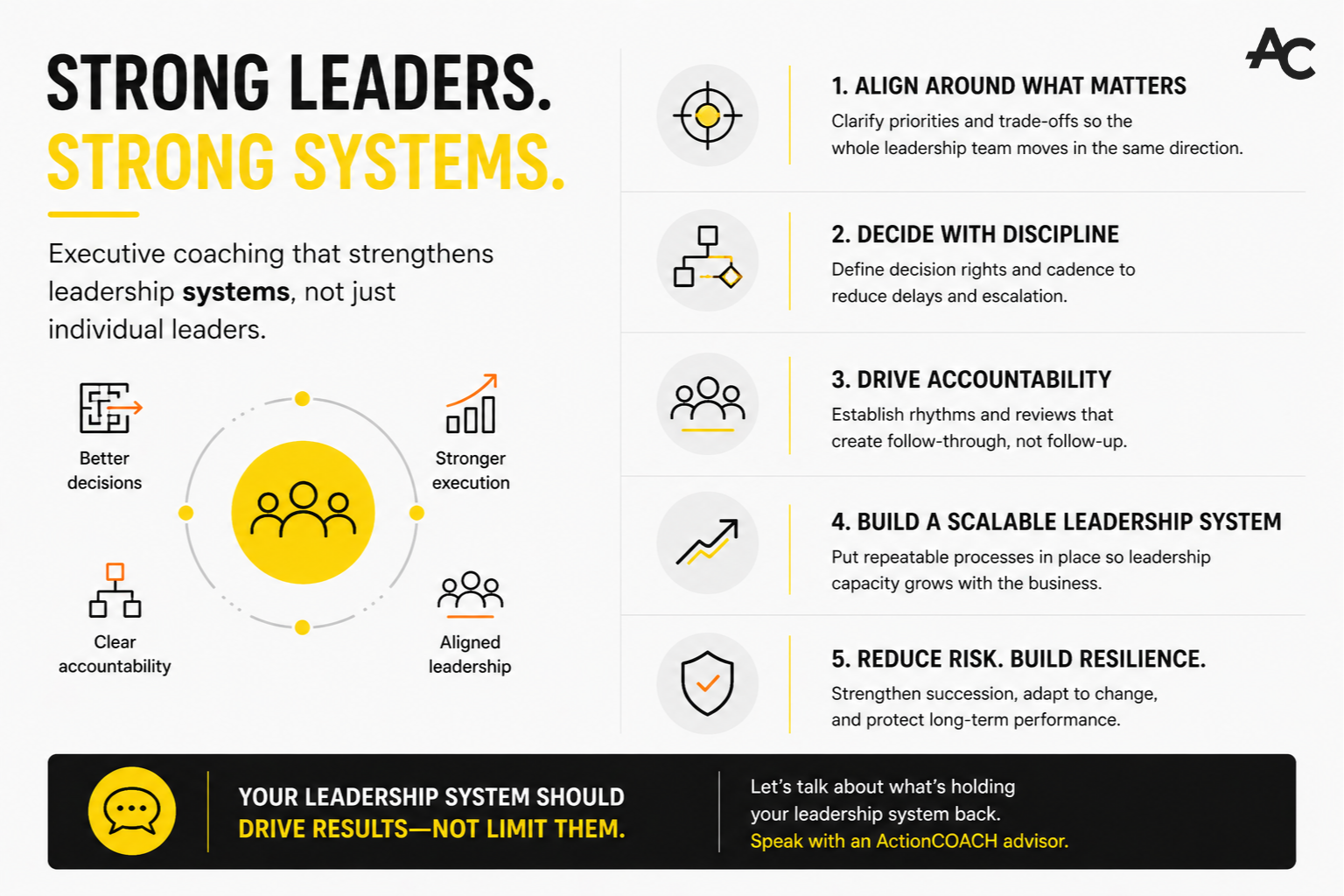
At the system level, an Executive Business Coach helps leadership teams clarify decision authority and establish cadence, reducing friction around escalation. This work focuses on improving how decisions move through the organisation and how leaders act on them.
Clear decision discipline shortens delays and reduces rework that late changes or conflicting direction often create.
How does executive coaching align senior leaders around shared priorities?
In many organisations, strategy fails during translation. Senior leaders may agree on direction but disagree on sequencing or trade-offs. Executive coaching helps surface these gaps early and convert strategic intent into a shared execution focus.
Alignment at this level typically reduces internal competition and improves delivery.
Accountability weakens when expectations remain implicit, which often leads to informal workarounds and repeated escalation. System-level coaching introduces operating rhythms and review cadences that hold leaders accountable to each other without relying on top-down enforcement.
This approach improves consistency and preserves autonomy.
How does system-level executive coaching support senior leadership development?
Skills training improves individual capability, but it does not change how leaders interact under pressure in real operating conditions. Without system changes, improved skills rarely compound across the organisation.
System-level coaching helps development translate into consistent leadership behaviour across the organisation.
Many organisations rely on individual effort to compensate for unclear systems, particularly during periods of growth. Over time, this pattern creates burnout and dependency on specific leaders. Structural clarity allows leadership capacity to scale without increasing individual workload.
When should senior leadership teams consider an Executive Business Coach?
Common signals include recurring execution issues, stalled strategic initiatives, repeated decision reversals, and increased escalation to the most senior leaders. These patterns indicate system constraints rather than performance gaps.
Senior teams often share blind spots created by proximity and shared history. An Executive Business Coach provides neutral perspective, pattern recognition, and structured challenge without internal organisational politics.
How does executive business coaching reduce leadership risk over time?
System-level coaching reduces reliance on individual leaders by establishing shared processes and decision standards. This improves succession readiness and reduces disruption during leadership transitions.
During periods of change, clear leadership systems keep execution stable by defining decision rights and review rhythms that allow organisations to adapt without losing control.
Where does ActionCOACH support leadership systems at scale?
ActionCOACH works with senior leaders to establish operating rhythms and clarify priorities through structured executive business coaching programmes, embedding accountability structures that support consistent execution.
At scale, executive coaching supports governance by strengthening leadership alignment, improving decision quality, and reinforcing long-term organisational performance.
Is an Executive Business Coach the right next step for strengthening your leadership system?
When leadership capability is strong, but execution remains inconsistent, systemic constraints usually cause the problem. Many leadership teams explore this shift after they see how other leadership teams have applied this approach. Executive business coaching addresses these constraints by improving how leaders operate together and how leadership performance is sustained across the organisation.
Assess whether your leadership system can scale!
If you are leading other leaders and execution feels harder than it should, a structured conversation can help clarify whether the constraint is individual capability or the leadership system itself.
Speak with an ActionCOACH advisor to explore how system-level executive business coaching supports decision discipline, alignment, and accountability at scale.
