
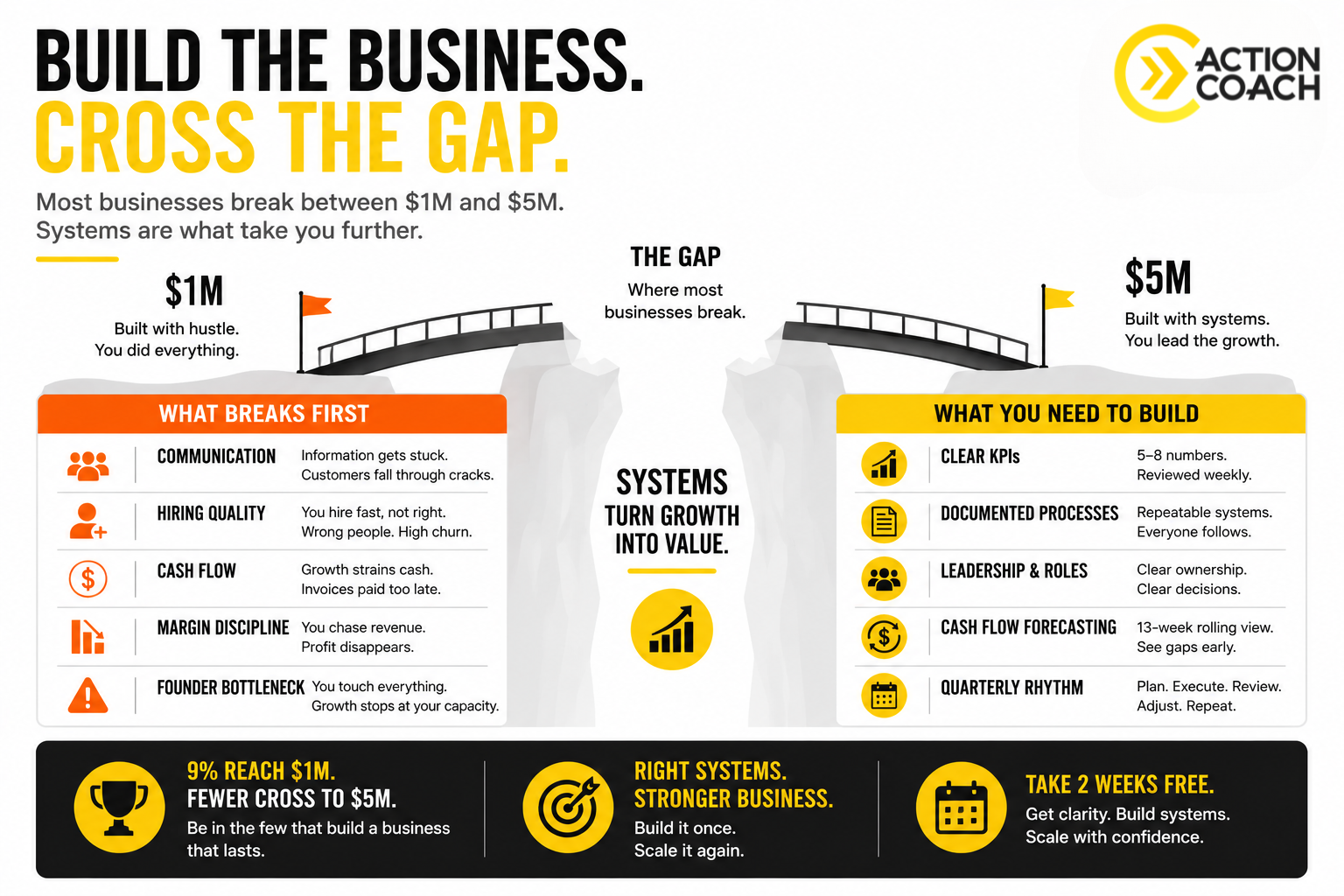
I've watched thousands of businesses hit $1 million in revenue and celebrate like they've made it.
Then I've watched most of them implode between $1M and $5M.
The statistics are brutal. Only 9% of small businesses ever reach $1 million in revenue. You're already in rare territory. But here's what nobody tells you at the champagne toast: the next phase is where most businesses die.
Growth doesn't fix broken systems. It exposes them.
I've spent 30 years coaching businesses through this exact transition. The $1M to $5M range isn't just another growth stage. It's a complete business transformation that requires different thinking, different systems, and a different version of you as a leader.
Why the $1M–$5M Range Is the Most Dangerous Growth Stage
You built a million-dollar business on hustle, instinct, and your ability to be everywhere at once.
That approach stops working around $1.2M.
Here's what changes:
Complexity multiplies faster than revenue. Every new customer, every new team member, every new product line adds exponential complexity to your operations. The informal systems that worked when you had 10 customers and 3 employees collapse under the weight of 100 customers and 15 employees.
Your team size doubles or triples. You go from knowing everyone's birthday to not knowing everyone's name. Communication that happened naturally around a single table now requires structure. The culture you built through osmosis needs intentional design.
You can no longer touch everything. This is the hardest transition for most founders. The business outgrows your capacity to be involved in every decision, every sale, every client relationship. Your superpower becomes your bottleneck.
When companies reach roughly 100 employees or $10 million in annual revenue, they consistently outgrow their existing processes and systems. Sometimes the pain hits earlier, at $5 million. Sometimes at $3 million.
The timeline varies. The outcome doesn't.
Without the right infrastructure, you plateau or implode.
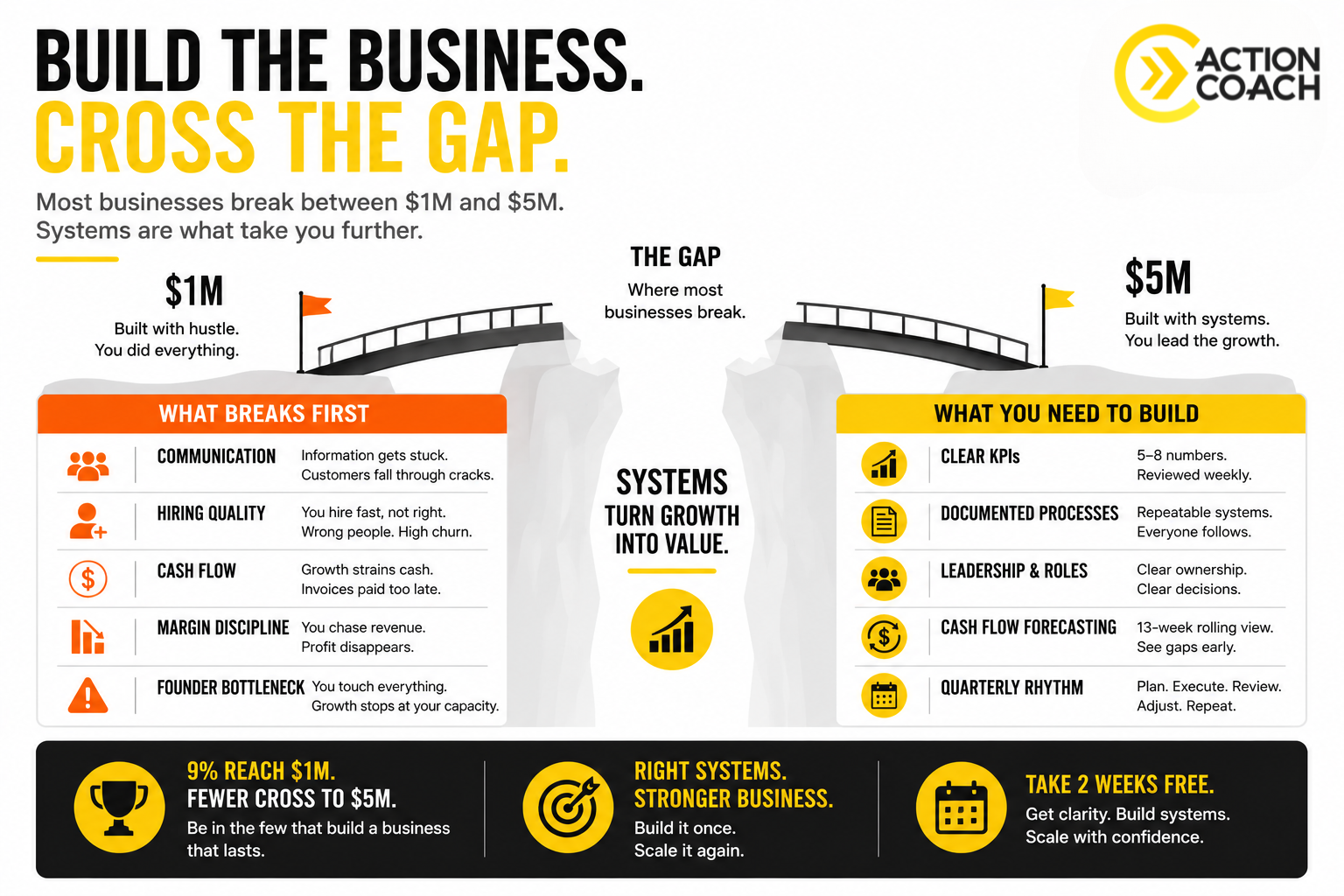
What Breaks First When You Scale
I can predict what will break in your business before it happens.
After coaching thousands of businesses through this phase, the pattern is consistent:
Communication breaks down first. Information that used to flow naturally now gets stuck. Your team makes decisions based on outdated information or no information at all. Customers fall through cracks you didn't know existed.
Hiring quality deteriorates. You're desperate for help, so you hire fast instead of hiring right. You bring on people who worked at bigger companies but can't operate in your environment. Or you hire people who match your old size but can't grow with you.
Cash flow timing becomes critical. Cash flow disruptions affect 88% of small businesses, but fewer than one-third take steps to address them. You're growing revenue but running out of money because growth demands working capital before it generates returns.
Over half of small businesses report being owed an average of $17,500 from unpaid invoices. Nearly half have invoices overdue by more than 30 days. This creates a devastating ripple effect on your capacity to grow.
Margin discipline disappears. You chase revenue at any cost. You discount to close deals. You take on unprofitable clients because you need the cash flow. Your revenue grows but your profit doesn't.
Here's the truth: revenue grows faster than infrastructure in almost every scaling business.
You add customers before you add systems to serve them well. You hire people before you create roles to guide them effectively. You expand geographically before you build operations to support multiple locations.
This gap between growth and infrastructure is where businesses break.
The Systems You Must Build Before Scaling
You need infrastructure before you need it.
That sounds obvious, but most business owners wait until they're drowning to build systems. By then, you're building the plane while flying it, and the turbulence is severe.
Here are the non-negotiable systems you need in place before you scale past $1M:
Clear KPIs reviewed weekly. You need 5-8 metrics that tell you the health of your business at a glance. Revenue is not enough. You need leading indicators that predict problems before they become crises.
Organizations that implement clear response protocols for KPI deviations achieve 31% higher success rates in meeting performance targets. It's not just about having metrics. It's about having systems to act on them.
Documented sales process. Your sales can't live in your head or in the head of your top salesperson. Every step from lead generation to close needs documentation. Every objection needs a response. Every transition point needs ownership.
Defined leadership roles. Who owns what? Who makes which decisions? Who has authority to spend money, hire people, change processes? Ambiguity at the leadership level creates chaos at every level below.
Cash flow forecasting. You need 13-week rolling cash flow projections updated weekly. You need to see the gaps before they arrive. You need to know when growth will strain cash and plan accordingly.
With more than 90% of revenue consumed by operational costs, small business owners juggle fragile cash flow constantly. 45% of U.S. small business owners forego their own paychecks due to cash flow shortages. This is not sustainable.
Quarterly planning rhythm. You need a cadence for setting priorities, reviewing progress, and adjusting strategy. Monthly is too frequent to see patterns. Annually is too slow to respond to market changes. Quarterly is the rhythm of high-performing businesses.
Without these five systems, growth creates chaos instead of value.
The Biggest Mistakes Between $1M and $3M
Hiring too fast without clarity of roles.
This is the number one mistake I see. You feel overwhelmed, so you hire people to relieve the pressure. But you haven't defined what success looks like in the role. You haven't documented the processes they'll follow. You haven't clarified how they'll interact with the rest of the team.
More people does not equal more performance.
More people without clear roles equals more confusion, more conflict, and more cost.
Here's what happens: you hire someone who seems great in the interview. They start strong. Then they stall because they don't know what to do or how to do it. You get frustrated because they're not performing. They get frustrated because they don't have the support to succeed. Eventually they leave or you let them go, and you're back where you started, just poorer and more cynical.
Investing in marketing before investing in systems.
Should you invest in marketing or systems first?
Systems first. Every time.
Marketing amplifies what you already do. If your operations are a mess, marketing just brings you more customers to disappoint. If your fulfillment is inconsistent, marketing accelerates your reputation damage. If your cash flow is fragile, marketing can push you into insolvency by growing faster than you can fund.
Fix the engine before you step on the gas.
Neglecting margin discipline.
What margin should you target in the $1M to $5M range?
A healthy target is 15-25% net margin in many service-based models. Lower than 10% is fragile at scale. You have no buffer for mistakes, no capacity to invest in growth, no cushion when markets shift.
I've seen businesses do $3 million in revenue and take home less than the owner made when the business was doing $800K. That's not growth. That's a more expensive job.
Ignoring culture as the business grows.
Culture matters more as you scale, not less.
When you were small, your energy carried the culture. Your presence set the tone. Your example defined the standard.
As you grow, you need repeatable behaviors that don't depend on you being in the room. You need values that guide decisions when you're not there to make them. You need standards that persist when you're focused elsewhere.
Culture is what happens when you're not watching.
The Critical Role of a Second-in-Command
How important is a second-in-command when scaling from $1M to $5M?
Critical.
Without a strong second-in-command, you remain the bottleneck for every decision, every problem, every opportunity. Your business can't grow faster than your capacity to process information and make decisions.
Here's what a great second-in-command does:
They own operations while you focus on strategy and growth. They translate your vision into executable plans. They hold the team accountable to standards when you're pulled in other directions. They make the hundreds of small decisions that keep the business running smoothly.
They free you to work on the business instead of in it.
Most importantly, they create accountability for you. A second-in-command who understands the vision and has the authority to execute will push back when you're about to make a decision that conflicts with your stated priorities. They'll remind you of commitments you made. They'll protect the business from your worst impulses.
You need someone who can run the business without you for two weeks. If you can't take a two-week vacation without everything falling apart, you don't have a business. You have an expensive job.
The Hidden Risk Nobody Talks About
Cash flow compression is the biggest hidden risk in the $1M to $5M growth phase.
Here's how it happens: you land a big contract that will transform your business. You celebrate. Then you realize you need to hire people, buy equipment, or increase inventory before you get paid. You're funding growth out of existing cash flow, and suddenly you're stretched thin.
Scaling increases working capital demands. You need more inventory. You have longer payment cycles. You're paying people before customers pay you. You're investing in systems and infrastructure that won't generate returns for months.
The business looks healthy on paper. Revenue is growing. Profit margins are acceptable. But you're running out of cash.
This is why cash flow forecasting is non-negotiable. You need to see the gaps coming and plan for them. You need to know when to slow growth to protect cash. You need to know when to seek outside capital to fund expansion.
Every business has 5-8 critical processes that give it a competitive advantage. If these aren't running smoothly, you'll scale your problems when you scale the business. Cash flow management is always one of those critical processes.
How ActionCOACH Business Systems Help You Scale Without Breaking
I built ActionCOACH because I lived this transition myself. Multiple times. Across multiple businesses.
I made every mistake in this article. I hired too fast. I chased revenue without protecting margin. I waited too long to build systems. I tried to do everything myself until I nearly broke.
Then I learned what actually works.
The ActionCOACH Business Operating System gives you the exact framework to scale from $1M to $5M without the chaos. We've refined this system over 30 years and thousands of clients. We know what works because we've seen what doesn't.
Here's what you get:
Clear KPIs tailored to your business model. We help you identify the 5-8 metrics that actually matter, build dashboards to track them, and create response protocols when they move off track.
Documented processes for your critical systems. We work with you to map, document, and optimize the processes that drive your competitive advantage. Sales, fulfillment, hiring, cash management—all documented so they run without you.
Leadership structure that scales. We help you define roles, clarify decision rights, and build the leadership team that can execute without constant supervision.
Cash flow forecasting and management. We implement 13-week rolling forecasts and teach you how to read them, respond to them, and use them to make better decisions about growth.
Quarterly planning rhythm. We facilitate your quarterly planning sessions, help you set priorities, and hold you accountable to execution between sessions.
This isn't theory. This is the proven system that has helped thousands of businesses break through the $1M to $5M barrier without breaking themselves.
You don't have to figure this out alone. You don't have to make all the mistakes I made. You can learn from three decades of experience and apply what actually works.
Try ActionCOACH free for 2 weeks. Work with a business coach who has guided hundreds of businesses through this exact transition. Get clarity on your biggest bottlenecks, build your first 13-week cash flow forecast, and identify the systems you need to scale sustainably.
No risk. No long-term commitment. Just two weeks of focused coaching to see if this is the right fit for your business.
Because you didn't build a million-dollar business to plateau at $1.2M.
You built it to scale, to create freedom, and to build something that works without consuming you.
Let's make that happen.
