

Most coaching firms will die with their founders.
That's the uncomfortable truth about our industry. While we help other businesses scale and systematize, most of us remain trapped in the same founder-dependent model that kills long-term value.
I've spent over 30 years building and scaling businesses. What I've learned is that coaching sits at a critical evolutionary moment. We're about 20 years behind financial planning firms and roughly 100 years behind accounting and legal practices in our structural development.
The solution isn't hiring more employees. It's building partnership structures that create ownership alignment and sustainable growth.
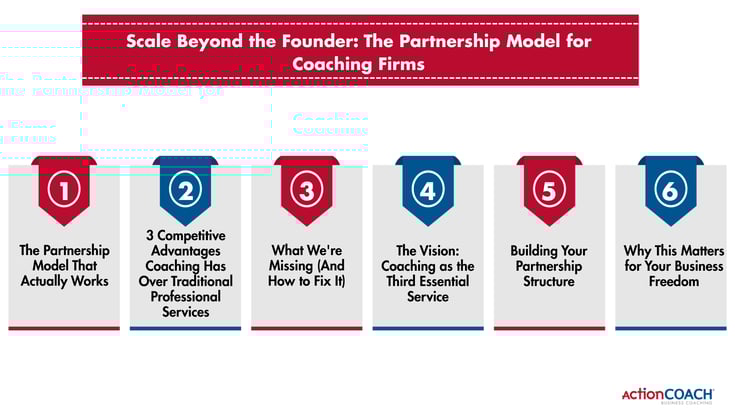
The Partnership Model That Actually Works
Here's how professional services evolved, and how coaching can follow the same path.
Traditional firms started with a founder-centric model. One expert doing all the work, taking all the risk, capturing all the upside. Sound familiar?
The breakthrough came when these founders realized they needed to transition productive team members from employees to partners. Not through selling equity cheaply, but through structured buy-ins that create skin in the game.
The model works like this: associates, junior partners, senior partners, with the founder maintaining a controlling interest as the name partner. Each level has increasing ownership stakes and corresponding responsibilities.
This creates what I call "aligned incentives." Partners don't just work for a paycheck. They work to build something they own.
Three Competitive Advantages Coaching Has Over Traditional Professional Services
Most coaches don't realize the structural advantages we possess compared to accountants and lawyers.
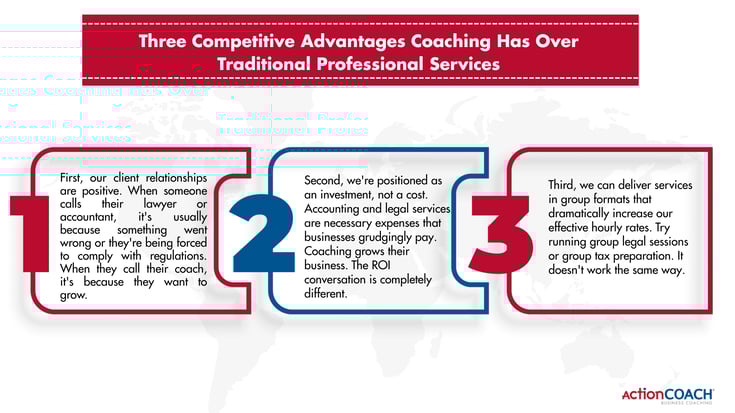
First, our client relationships are positive. When someone calls their lawyer or accountant, it's usually because something went wrong or they're being forced to comply with regulations. When they call their coach, it's because they want to grow.
That's a fundamental difference in client psychology.
Second, we're positioned as an investment, not a cost. Accounting and legal services are necessary expenses that businesses grudgingly pay. Coaching grows their business. The ROI conversation is completely different.
Third, we can deliver services in group formats that dramatically increase our effective hourly rates. Try running group legal sessions or group tax preparation. It doesn't work the same way.
These advantages position coaching firms for potentially higher profitability and client satisfaction than traditional professional services.
What We're Missing (And How to Fix It)
We lack two key advantages that established professional services enjoy.
We don't have standardized university training programs producing ready-to-work graduates. Accounting and law schools create a pipeline of trained professionals. Coaching programs are still fragmented and inconsistent.
We also don't have government-mandated requirements. Businesses must have accountants and lawyers. Coaching remains optional.
But I'm seeing early signs of change. More universities are adding coaching courses. The business world increasingly recognizes coaching as essential, not optional.
The Vision: Coaching as the Third Essential Service
I envision a future where every business automatically engages "the 3 As" when starting: Accountant, Attorney, and Action Coach.
This isn't just about traditional one-on-one coaching. It includes virtual coaching, training programs, and digital resources that establish coaching as a standard business necessity.
The businesses that build partnership structures now will dominate this future market. They'll have the systems, the team depth, and the scalability to handle massive growth.
Building Your Partnership Structure
Start by identifying your highest-performing team members. Look for people who think like owners, who care about client outcomes beyond their job description.
Create a clear pathway from employee to associate to partner. Define the buy-in requirements, the ownership percentages, and the performance expectations at each level.
Structure the financial arrangements so partners buy in rather than you selling out. This maintains your control while creating their commitment.
Most importantly, document everything. Partnership agreements, performance metrics, buy-in processes. The structure itself becomes a competitive advantage.
Why This Matters for Your Business Freedom
Remember, the goal isn't just to build a bigger business. It's to build a business that works without you.
Partnership structures create this freedom because success no longer depends entirely on your personal involvement. Partners have ownership stakes that motivate them to maintain and grow the business even when you step back.
This aligns perfectly with my core belief about entrepreneurship: build something that generates wealth and freedom, not just another job that requires your constant presence.
The coaching industry stands at an inflection point. We can continue operating as individual practitioners who build practices that die with us, or we can evolve into structured firms that create lasting value.
The choice determines not just your business's future, but the entire industry's trajectory toward becoming an essential professional service alongside accounting and law.
The partnership model isn't just about scaling revenue. It's about building something that outlasts you while giving you the freedom to focus on what matters most.
That's how you create real wealth and real freedom through coaching.
If you're ready to scale your coaching firm beyond the founder model, let's talk.
Book a free discovery call to explore how the ActionCOACH partnership structure and ABOS systems can help you create lasting value, ownership alignment, and true business freedom.
