
You learned your trade. You mastered your craft. You opened your doors.
And then the real education started.
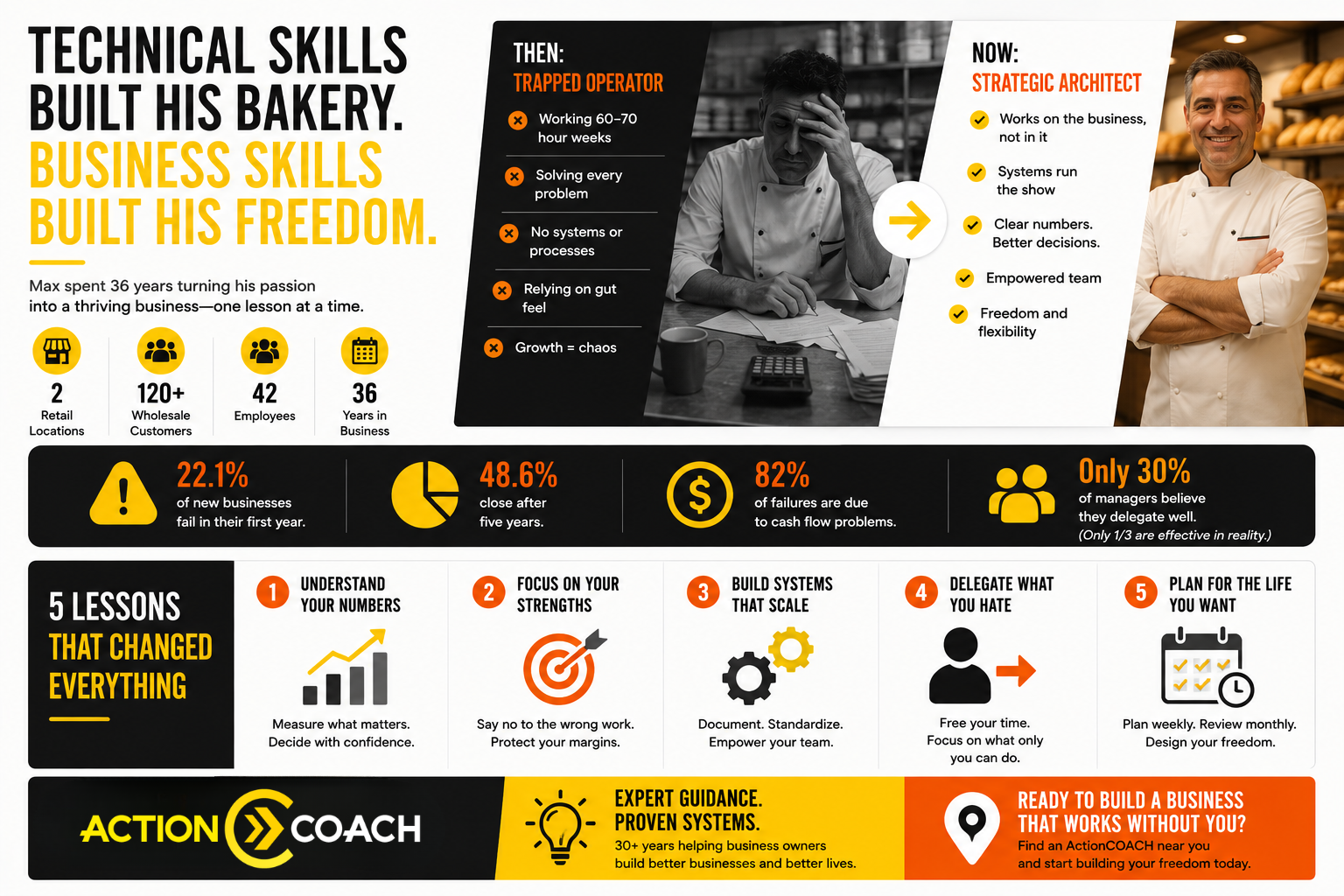
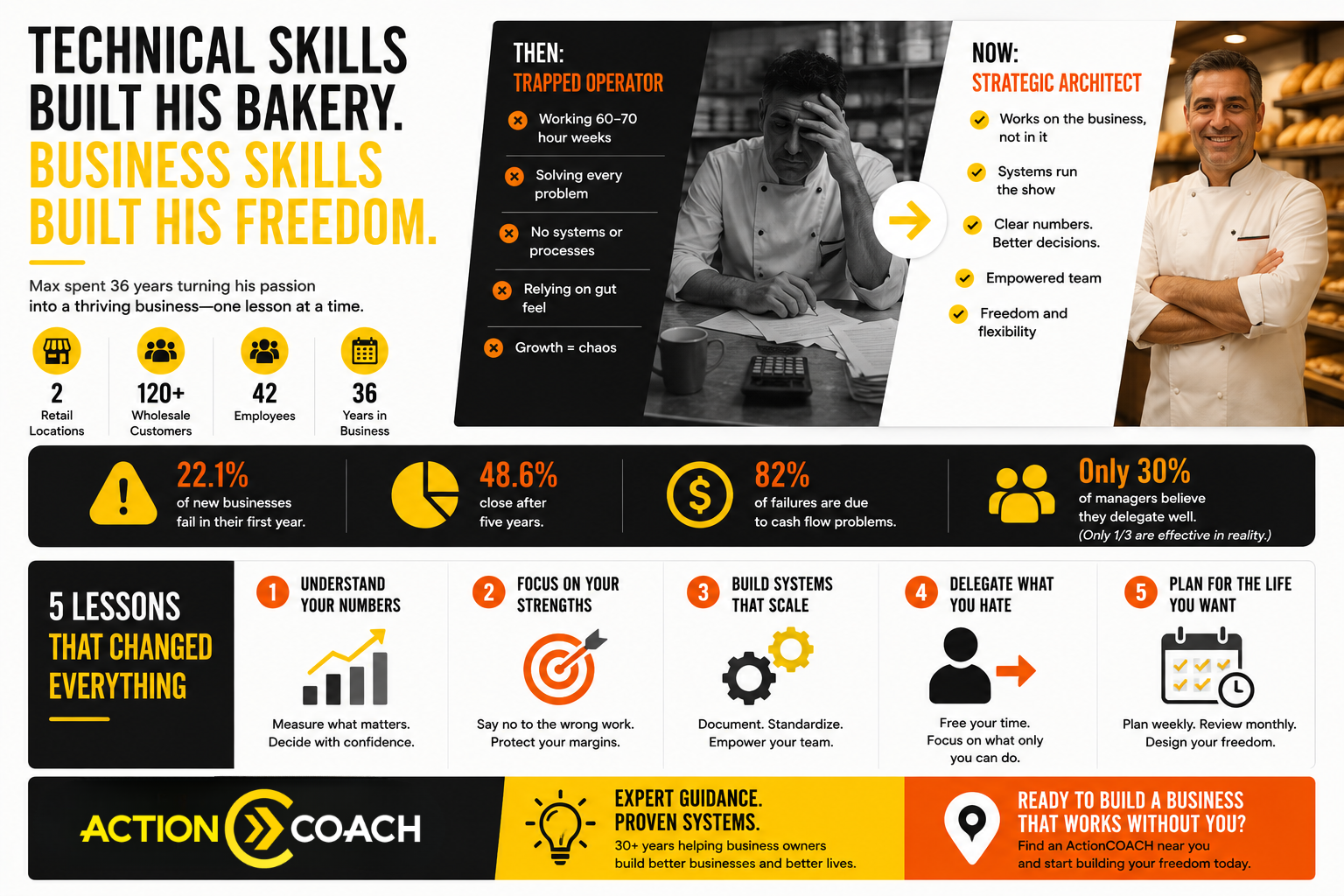
Max spent 36 years building his Arab bakery in Wellington, New Zealand. Two retail locations. Over 120 wholesale customers. 42 employees. From the outside, it looks like a success story built on exceptional pastry skills and Swiss apprenticeship training.
From the inside, it's a completely different narrative.
His journey exposes a brutal truth that destroys thousands of skilled tradespeople every year: being great at what you do has almost nothing to do with running a successful business.
The Fatal Assumption That Kills Businesses
Michael Gerber's research on the E-Myth reveals something most entrepreneurs discover too late: a talented baker might open a bakery because they have excellent baking skills, but having the technical skill to make pastries does not automatically impart the know-how to run a successful bakery business.
The numbers confirm this reality.
22.1% of new U.S. businesses fail within their first year. 48.6% close after five years. Technical expertise doesn't guarantee survival.
Max experienced this gap firsthand. His apprenticeship taught him how to create exceptional pastries. It taught him nothing about cash flow, client concentration risk, or building systems that work without him.
"I started with technical skills," Max reflects. "But I had to learn business skills the hard way."
The hard way meant 14-hour days. Bounced checks. Sleepless nights wondering if he could make payroll.
When Success Creates New Problems
Max's bakery experienced 5x growth in year one.
Most people would call that success. Max calls it chaos.
Rapid expansion exposed every weakness in his operation. What worked as a solo baker making pastries broke completely when he needed to manage staff, maintain quality across multiple locations, and serve 120 wholesale accounts.
The growth revealed three critical gaps:
Systems debt. Without documented processes, knowledge degraded as it passed through his growing team. What Max knew in his head couldn't transfer to 42 employees. Quality became inconsistent. Mistakes multiplied.
Financial blindness. According to SCORE, 82% of small businesses fail due to cash flow problems. Max was running his bakery on gut feel and basic accounting reports. He had no KPIs, no channel-specific metrics, no early warning system for problems.
Client concentration risk. When a major client with 8-9 store locations walked away, Max felt the impact immediately. Industry experts warn that optimal customer concentration is less than 10% of sales from a single customer and less than 25% from the top five customers. Max learned this lesson through painful experience.
The Three Personalities You Need to Master
Everyone who starts a business eventually learns that making it work takes three distinct personalities.
The Technician does the work of making it, selling it, and delivering it.
The Manager focuses on achieving results through people and systems so the business can sustain itself and grow.
The Entrepreneur defines the vision for the business and closes the gap between where you are today and where you want to be.
Most entrepreneurs are Technicians who had what Gerber calls an "entrepreneurial seizure." They started a business because they were good at something.
Max was a master baker. But technical skill isn't the same as entrepreneurial skill.
Without systems (the Manager) and vision (the Entrepreneur), your business becomes a job you can't quit. You work longer hours than you ever did as an employee. You earn less per hour. You carry all the risk.
Max spent years trapped in this pattern. Working in the bakery instead of on the business. Solving the same problems repeatedly because he never built systems to prevent them.
The Turning Point: When Numbers Replace Gut Feel
Max's transformation started when he stopped relying on instinct and started measuring everything.
Retail performance. Wholesale accounts. Online sales. Third-party delivery channels.
The shift from operator to business owner happens when you understand your numbers. When you can look at data and make strategic decisions instead of reactive choices.
According to research published in the Harvard Business Review, companies that implement effective management systems experience a 20% increase in employee productivity. The National Federation of Independent Business found that businesses embracing systematic approaches saw an average growth rate of 15% per year, while those without structured models experienced only 5% growth.
Max implemented KPIs across his operation. The data revealed opportunities he'd missed and problems he hadn't seen.
One wholesale account was consuming resources without generating profit. Two retail locations had completely different customer behaviors that required different strategies. Online sales were growing faster than he realized.
You can't manage what you don't measure.
Building a Business That Works Without You
At 36 years in, Max is finally building the business he should have started with.
Systems documentation ensures consistency. Standard operating procedures prevent the "telephone game" effect where instructions degrade as they pass through the team. New employees can be trained efficiently. Quality remains consistent whether Max is there or not.
Michael Gerber emphasizes this principle: "The system runs the business and the people run the system."
This approach transforms your company into a predictable, profitable, and scalable operation. Investors and buyers value businesses with structured systems because they reduce risks associated with talent turnover.
Max's long-tenured employees now embody the company culture. They filter out poor cultural fits during hiring. They maintain standards without constant supervision. The business operates with less direct involvement from Max.
That's freedom.
What Max Would Do Differently
Looking back across 36 years, Max offers one clear reflection:
"I would start with a plan."
He had vision. He knew what he wanted to build. But he lacked the systematic roadmap to get there efficiently.
The result was decades of reactive management. Daily operations consumed energy that should have been directed toward strategic advancement. Problems that could have been prevented through proper planning became expensive lessons learned through experience.
First-time founders have an 18% success rate. Entrepreneurs who previously succeeded enjoy a 30% success rate on subsequent ventures. Experience matters.
But you don't have to spend 36 years learning these lessons yourself.
The Persistence Advantage
Max's competitive advantage wasn't superior baking skills or brilliant strategy.
It was persistence.
The willingness to "grip your teeth" and continue through bounced checks, lost clients, and growth pains. Most competitors quit before you do.
A landscape contractor whose business was "eating him alive" adopted E-Myth principles. Three years later, his company grew from $500K to nearly $3 million in revenue. More importantly, he got his life back.
Persistence must be coupled with flexibility and problem-solving orientation. Stubbornly doing the wrong thing for 36 years isn't a strategy. Consistently adapting, learning, and improving while refusing to quit is.
Your Next Move
You face a choice.
You can spend the next 36 years learning these lessons through expensive experience. Bounced checks. Lost clients. Sleepless nights. Slow, painful progress toward a business that might eventually work without you.
Or you can learn from someone who's already walked this path.
Max's journey demonstrates what thousands of ActionCOACH clients have discovered: technical expertise gets you started, but business systems get you free.
The transition from tradesman to business owner requires specific skills. Financial literacy. Systems thinking. Strategic planning. Team development. These capabilities don't come naturally to most technical experts.
They can be learned.
ActionCOACH has spent 30+ years helping entrepreneurs make this exact transition. Not through theory, but through proven systems that work in the real world.
You deserve a business that works without consuming your life. You deserve to build something valuable, scalable, and eventually sellable.
The question is whether you're willing to learn the skills that make it possible.
Take the first step. Find out how ActionCOACH can help you build the systems, implement the metrics, and develop the strategic clarity that transforms technical expertise into business success.
Your 36-year journey doesn't have to take 36 years.
