
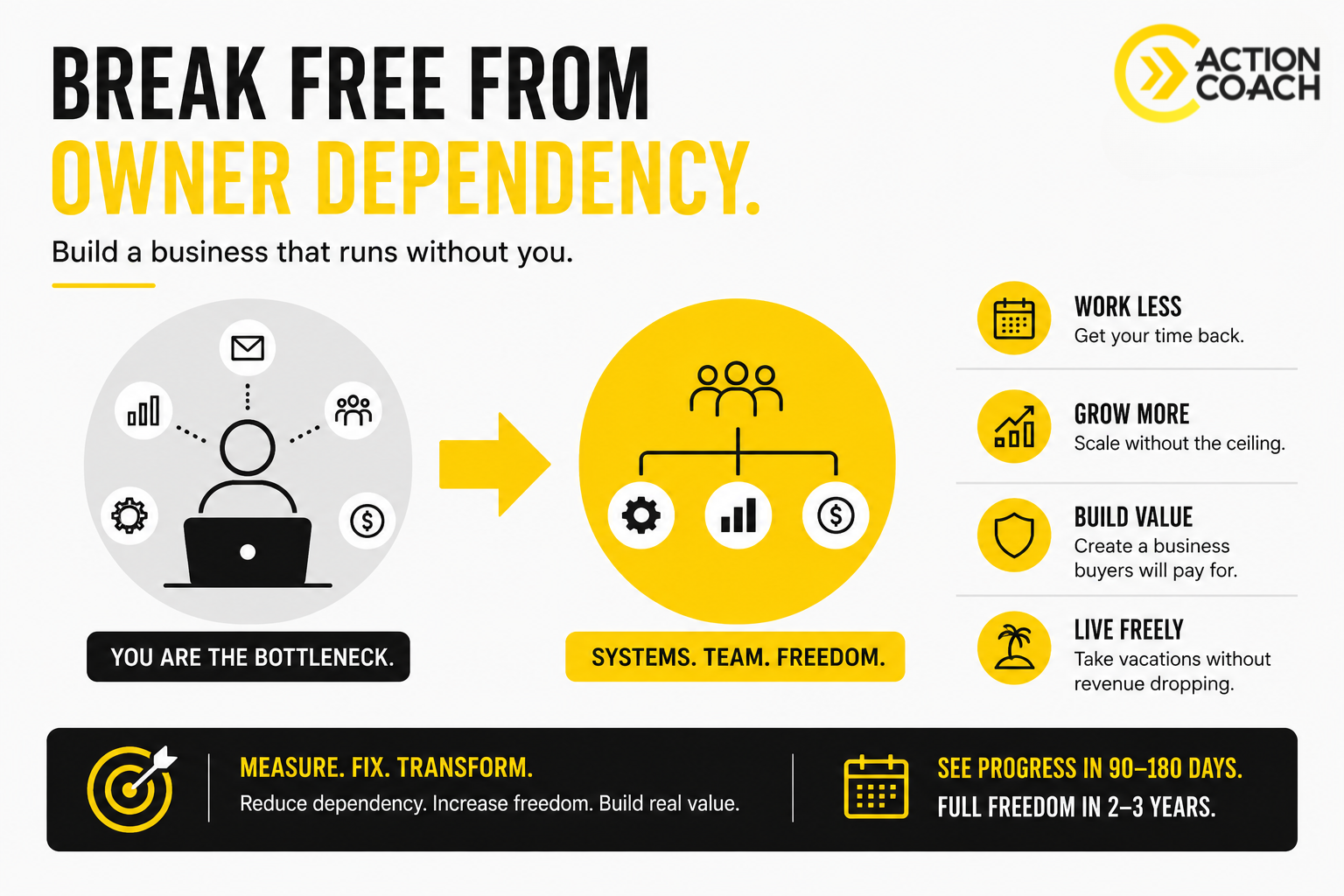
You work 60-hour weeks. Revenue drops the moment you take vacation. Your team waits for your approval on every decision.
You don't own a business. You own a very expensive job.
This is owner dependency, and it's quietly destroying the value of your company while burning you out in the process. The good news? You can measure it. And once you measure it, you can fix it.
What Owner Dependency Actually Means
Owner dependency happens when your business can't function without you in the driver's seat every single day.
Here's what it looks like:
- Every decision bottlenecks at your desk. Your team won't move forward without your green light.
- Clients only trust you. They hired your company because they want to work with you specifically.
- No systems exist outside your head. Processes live in your memory, not in documented workflows.
- Your team freezes without you. When you're gone, productivity drops or stops entirely.
This creates two massive problems: income insecurity and burnout.
You can't scale because you're the constraint. You can't sell because buyers won't pay premium multiples for a business that collapses without its owner. You can't even take a real vacation without watching revenue decline.
How Common Is This Problem?
Extremely common.
We estimate that 70-80% of small businesses are heavily owner-dependent. For companies under $3 million in revenue, this number approaches universal.
You're not alone in this. But that doesn't make it acceptable.
The businesses that break through this ceiling don't do it by accident. They systematically reduce dependency through documented processes, clear decision rights, and team empowerment.
The Warning Signs You're Too Dependent
How do you know if your business is owner-dependent? Look for these red flags:
You work 50+ hours per week consistently. If you can't step away without everything falling apart, you're the bottleneck.
Revenue dips when you take time off. Your vacation becomes a revenue problem. That's a clear signal your business needs you to survive.
You have no second-in-command. No one on your team can make strategic decisions or handle client escalations without you.
Processes live in people's heads. New team members learn by shadowing, not by following documented systems. Knowledge transfer happens verbally, not systematically.
You're the only person who knows the numbers. Financial visibility stops with you. Your team doesn't know the KPIs that drive success.
If three or more of these apply to you, owner dependency is costing you money, time, and peace of mind.
How to Measure Owner Dependency
You can't fix what you don't measure. Here's how to score your business on owner dependency:
Decision Independence
What percentage of decisions can your team make without your approval?
- 0-25%: Critical dependency. You're involved in nearly everything.
- 26-50%: High dependency. Major decisions still require you.
- 51-75%: Moderate dependency. You're still the default escalation point.
- 76-100%: Low dependency. Your team operates autonomously within clear guidelines.
Process Documentation
What percentage of your core business processes are documented in writing?
- 0-25%: Knowledge lives in people's heads. High risk.
- 26-50%: Some documentation exists but gaps remain.
- 51-75%: Most processes documented but not consistently followed.
- 76-100%: Comprehensive documentation that guides daily operations.
KPI Visibility
Does your team know the key performance indicators that determine business success?
- No visibility: Only you track and understand the numbers.
- Limited visibility: Some team members see some metrics occasionally.
- Partial visibility: Department heads know their numbers but not company-wide KPIs.
- Full visibility: Everyone knows the metrics that matter and how their work impacts them.
Revenue Resilience Test
This is the ultimate measure. Take a week off. Completely off. No calls, no emails, no check-ins.
What happens to revenue?
- Drops 20%+: Critical owner dependency. Your business is you.
- Drops 10-20%: High dependency. The business struggles without you.
- Drops 5-10%: Moderate dependency. Some impact but manageable.
- Stable or grows: Low dependency. You built a real business.
If revenue drops significantly during your absence, you have a dependency problem that's costing you valuation, freedom, and growth potential.
The First Fix: Clarity of Roles and Decision Rights
You can't eliminate owner dependency overnight. But you can start reducing it today.
The first fix is simple: clarity of roles and documented decision rights.
Define three things:
1. What decisions can your team make independently?
Give them clear authority boundaries. Client refunds under $500? Team decides. Hiring decisions for their department? Team decides. Strategic partnerships? That escalates to you.
Write it down. Make it visible. Give your team permission to act.
2. What must escalate to you?
Be specific. Don't say "important decisions." Define what qualifies. Financial commitments over $10,000? Legal agreements? Major client disputes?
Clear escalation criteria eliminate the guessing game that keeps your team dependent on you.
3. What KPIs determine success?
Your team can't operate independently if they don't know what winning looks like.
Share the numbers. Revenue targets. Profit margins. Customer retention rates. Lead conversion percentages.
When your team knows the score, they can make better decisions without you.
The Timeline: How Long Does This Take?
Reducing owner dependency is a process, not an event.
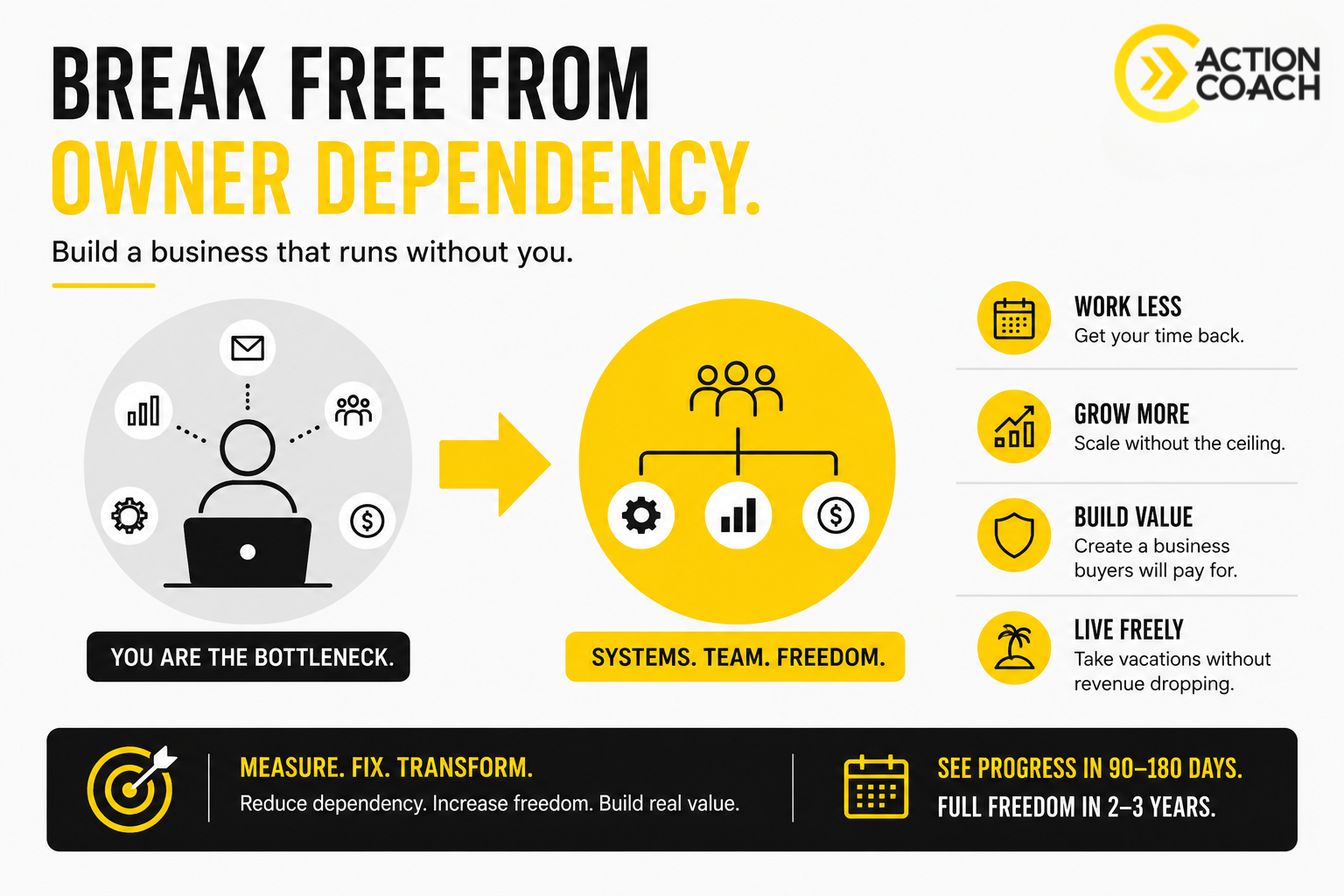
You'll see a measurable shift in 90-180 days if you commit to systematic change. Your team will start making more decisions. Processes will get documented. You'll work fewer hours.
But full freedom takes 2-3 years.
That's the reality. You're rewiring how your business operates. You're building systems, training leaders, and creating a culture of ownership.
It takes time. But the alternative is staying stuck in a business that demands your presence forever.
Why Owners Resist This Change
We've worked with thousands of business owners over 30 years. We know the resistance patterns.
Identity. You built this business. It's part of who you are. Stepping back feels like losing yourself.
Control. You're afraid your team will make mistakes. They will. That's how they learn.
Fear of irrelevance. If the business doesn't need you, what's your role?
These fears are real. But they're also keeping you trapped.
Your value isn't in doing everything. Your value is in building a business that works without you so you can focus on strategy, growth, and the parts of the business you actually enjoy.
Does Systemization Kill Culture?
No.
This is a common fear. Owners worry that documenting processes and creating systems will make their business feel corporate and soulless.
The opposite is true.
Systemization increases confidence. Your team knows what to do. They don't waste time guessing or waiting for your approval. They move faster and feel more capable.
Culture doesn't come from chaos. It comes from clarity.
When your team understands their role, has the authority to act, and knows the metrics that matter, they perform better and feel more engaged.
The Valuation Impact of Owner Dependency
Here's what owner dependency costs you when you're ready to sell:
Systemized businesses sell at 3-5x EBITDA. Buyers pay premium multiples for businesses that run without the owner.
Owner-dependent businesses sell at 1-2x EBITDA. Buyers discount heavily because they're buying a job, not an asset.
The difference is massive.
A business doing $500,000 in EBITDA could sell for $2.5 million if it's systemized or $750,000 if it's owner-dependent.
That's a $1.75 million difference based on whether you built systems or stayed the bottleneck.
Reducing owner dependency isn't just about lifestyle. It's about building real wealth.
How ActionCOACH Helps You Break Free
We've spent 30 years helping business owners transform owner-dependent businesses into systemized, scalable assets.
Here's how we do it:
We assess your current dependency level. Using proven frameworks, we measure exactly where you're stuck and what's keeping you there.
We document your processes. We work with you and your team to capture the knowledge that lives in people's heads and turn it into repeatable systems.
We clarify decision rights. We help you define what your team can decide, what escalates to you, and what metrics determine success.
We build your leadership team. We coach your second-in-command and department heads to think strategically and operate independently.
We track progress. Every 90 days, we measure dependency reduction. You'll see the numbers improve as your business becomes less reliant on you.
This is what we do. We turn owner-dependent businesses into real assets that create freedom, wealth, and options.
Take the First Step
You deserve a business that works without you.
You've built something valuable. Now it's time to make it sustainable.
Start by measuring your owner dependency. Use the scorecard in this article. Be honest about where you stand.
Then take action.
Document one core process this week. Define decision rights for one team member. Share one KPI dashboard with your team.
Small steps compound into massive change.
If you want help, we're here. ActionCOACH has helped thousands of business owners break free from owner dependency and build businesses that create real freedom. Take the first 2 weeks free to experience how coaching can transform your business without risk.
Your business should serve your life. Not consume it.
Find out how we can help you reduce dependency, increase valuation, and reclaim your time. Because if your business stops when you stop, you don't own a business.
You own a very expensive job. And you deserve better than that.
