
I've worked with thousands of business owners over 30 years.
Most of them make money. Fewer than half keep it.
The difference comes down to something most entrepreneurs never diagnose: profit leaks.
You're earning revenue. But somewhere between the sale and your bank account, profit disappears through inefficiency, poor pricing, labor creep, and systems that don't scale.
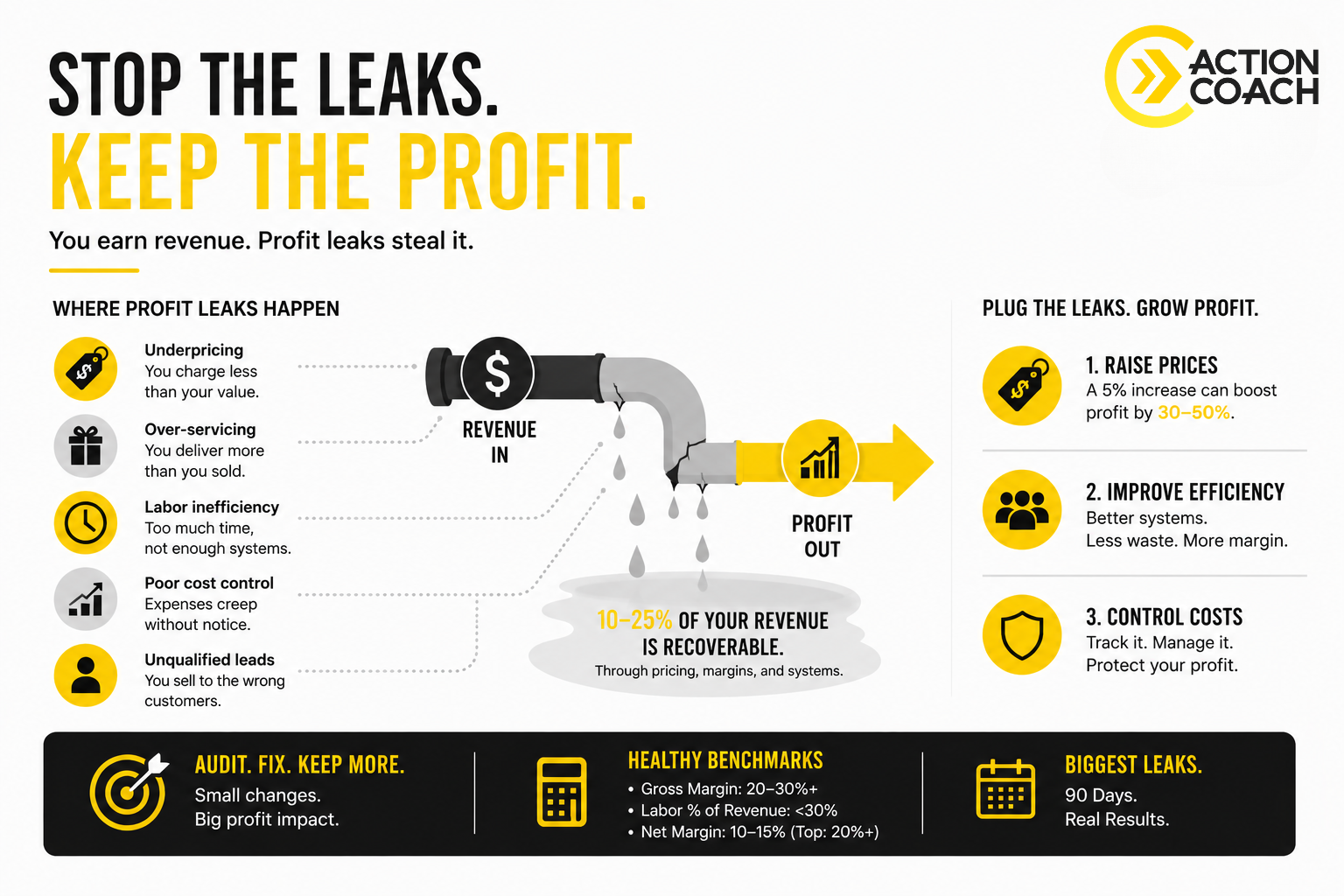
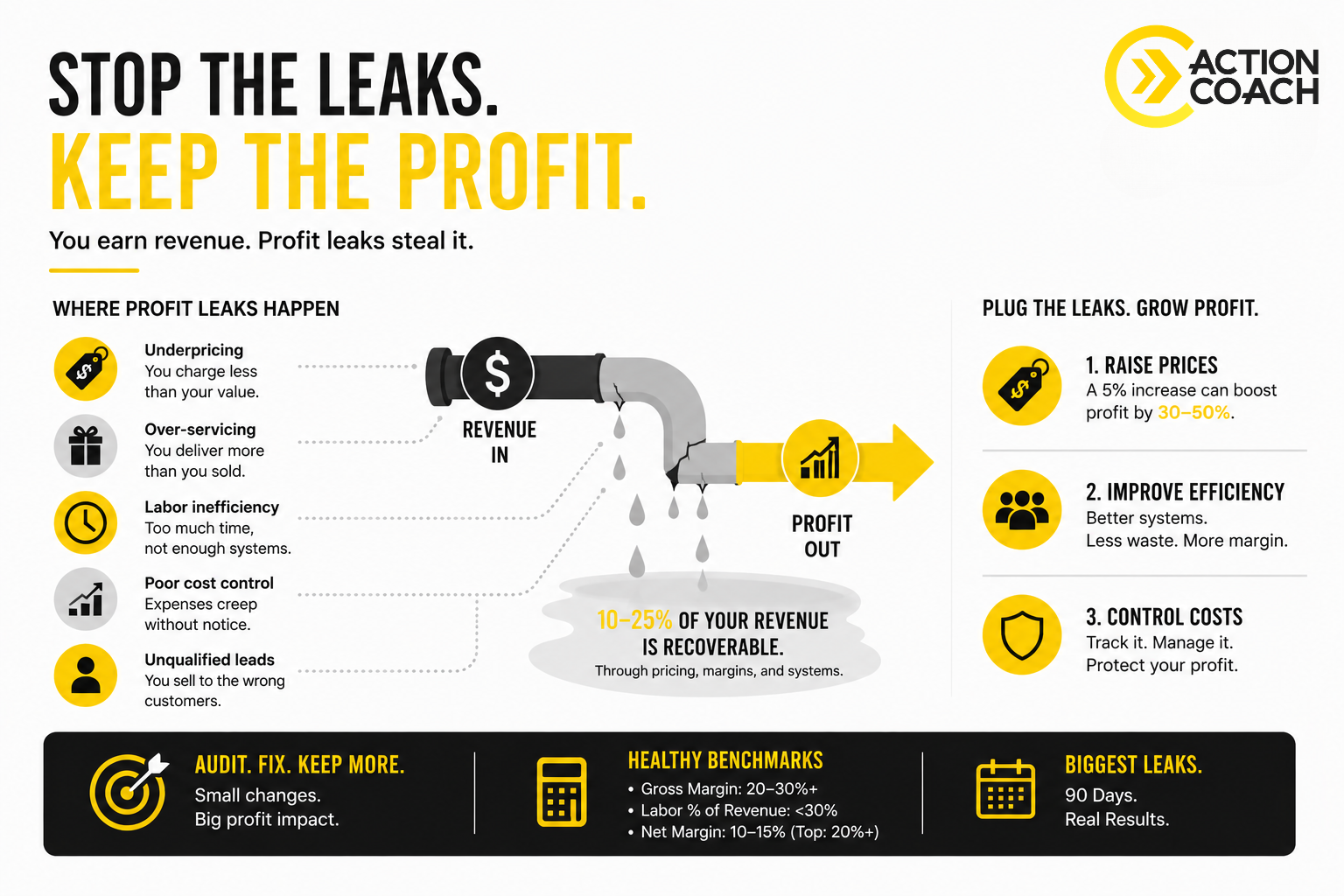
Here's what I know: 10–25% of your revenue is recoverable through pricing clarity, margin discipline, and better systems.
This isn't theory. It's math.
What Is a Profit Leak?
A profit leak is revenue you earned but profit you lost.
You made the sale. You delivered the work. But the money vanished before it hit your bottom line.
The most common leaks I see:
- Underpricing — You charge less than your value because you're scared to lose the deal
- Over-servicing — You deliver more than you sold because you want to impress
- Labor inefficiency — Your team takes longer than necessary because systems are missing
- Poor cost control — Expenses creep up without anyone noticing until the quarter ends
- Unqualified leads — You spend time selling to people who can't afford you or don't value what you do
Every single one of these leaks is fixable.
But you can't fix what you don't measure.
How Much Profit Are You Actually Losing?
Let me give you a benchmark.
The average small business in the U.S. earns a net profit margin of around 7% to 10%.
If your business does between $3M and $20M in revenue, a healthy net profit margin sits in the 10–15% range. Top performers push beyond 20%.
If you're below that range, you have leaks.
And here's the part that hurts: nearly 60% of small business failures are related to pricing and cash flow.
You're not failing because you can't sell. You're failing because you can't keep what you earn.
The Fastest Leak to Fix: Pricing
I'm going to tell you something you need to hear, not what you want to hear.
You're underpricing.
I don't care how confident you feel about your rates. Most business owners leave money on the table because they're afraid to charge what they're worth.
Here's the math that changes everything:
If you run a 10% net margin business and you raise prices by just 5%, you can increase profit by 30–50%.
Let me say that again.
A 5% price increase can deliver a 30–50% profit increase.
According to McKinsey & Company, pricing strategies yield a 2-7% increase in returns on every sale. Optimizing pricing delivers immediate revenue gains with relatively little effort.
But here's what stops you: fear.
You're afraid the customer will walk. You're afraid you'll lose the deal. You're afraid you're not experienced enough to charge that much.
That voice in your head? It's costing you real money.
Service providers suffering from imposter syndrome lose an average of $30,000+ annually by undercharging.
Let me flip the script.
If you aren't losing some percentage of bids, you aren't charging enough.
That's not failure. That's data. It means you've found your pricing ceiling instead of staying stuck at the floor.
Why Owners Don't Raise Prices
I've heard every excuse.
"My market won't pay more."
"My competitors charge less."
"I'll lose customers."
Here's the truth: you don't have a pricing problem. You have a positioning problem.
You haven't clarified your differentiation. You haven't built messaging that communicates value. You haven't given your customer a reason to pay more.
So you compete on price. And when you compete on price, you lose twice—once when you make the sale, and again when you deliver the work for less than it's worth.
The Other Leaks That Kill Your Profit
Pricing is the fastest fix. But it's not the only one.
Labor Creep
Labor typically represents the largest expenditure in most businesses—sometimes devouring 35% or more of total revenue.
In industries where manual labor is a major component, that percentage climbs even higher.
The optimal labor cost percentage sits around 25.7%. That balances cost control with enough investment in your workforce to maintain ethical practices, motivation, and engagement.
If your labor percentage is above 30%, you're bleeding profit.
Here's what causes labor creep:
- No standard operating procedures—every job takes longer because people figure it out as they go
- Poor project scoping—you underestimate hours and your team absorbs the overrun
- Lack of accountability—nobody tracks time, so nobody knows where hours go
You fix labor creep by building systems. Systems that define how work gets done, how long it should take, and who's responsible for each step.
Discounting
Every discount you give is profit you throw away.
I'm not saying never offer a discount. I'm saying every discount should have a strategic reason—and a limit.
If you're discounting to close deals, you're admitting your value proposition isn't strong enough.
Scope Expansion Without Billing
This one kills service businesses.
You quote a project. The customer asks for "just one more thing." You say yes because you want to keep them happy.
Then they ask for another thing. And another.
Before you know it, you've delivered twice the work for the same price.
That's not customer service. That's self-sabotage.
You need boundaries. You need change orders. You need to bill for scope changes the moment they happen.
How to Audit Your Profit
You can't fix leaks you can't see.
Here's the audit I run with every client:
1. Review Your Gross Margin Percentage
Gross margin is revenue minus cost of goods sold (COGS).
For service businesses, you should target a gross margin of 20–30% at minimum. If you're below that, your pricing or cost structure is broken.
2. Calculate Labor as a Percentage of Revenue
Take total labor costs—salaries, benefits, payroll taxes—and divide by total revenue.
If that number is above 30%, you have a labor efficiency problem.
Here are industry benchmarks based on US Census data:
- Manufacturing: 18%
- Healthcare: 45%
- Insurance: 9%
- Retail: 10–12%
Compare your number to your industry. If you're higher, you're overstaffed or underpriced.
3. Track Overhead Percentage
Overhead includes rent, utilities, software, marketing, admin salaries—everything that isn't directly tied to delivering your product or service.
Overhead should stay below 20–25% of revenue for most businesses.
If it's higher, you're spending too much on infrastructure relative to what you're earning.
4. Measure Net Margin Percentage
Net margin is what's left after all expenses.
For a healthy business doing $3M–$20M in revenue, net margin should sit in the 10–15% range. Top performers hit 20% or more.
If you're below 10%, you have multiple leaks. And they're costing you financial freedom.
How Quickly Can You Plug the Leaks?
Most business owners think fixing profit takes years.
It doesn't.
You can plug the biggest leaks in 60–90 days.
Here's how:
Step 1: Raise Prices on Your Next 10 Sales
Don't overhaul your entire pricing model overnight. Test a 5–10% increase on your next 10 deals.
Track how many customers push back. Track how many walk.
Most of the time, you'll lose fewer deals than you expect. And the profit increase will more than offset the lost volume.
Step 2: Audit Your Labor Costs by Project
Pull the last 10 projects you completed. Calculate actual hours worked versus hours quoted.
If you're consistently over, you have a scoping problem or a delivery problem. Fix the scoping first—it's faster.
Step 3: Cut One Overhead Expense
Look at your overhead line by line. Find one expense you can cut or renegotiate this month.
Software subscriptions you don't use. Office space you don't need. Vendor contracts you can renegotiate.
Every dollar you cut from overhead drops straight to your bottom line.
Revenue Hides Mistakes. Profit Exposes Them.
I've watched too many entrepreneurs chase top-line growth while their profit shrinks.
They think more sales will solve the problem. But profit doesn't scale unless your systems do.
You can grow revenue and still go broke.
Margin improvement delivers more stable profit than revenue growth alone. And it's faster.
You don't need to double your sales to double your profit. You need to stop the leaks.
How ActionCOACH Helps You Plug the Leaks
For over 30 years, I've helped thousands of business owners recover profit they didn't know they were losing.
We don't just tell you what's wrong. We show you how to fix it—step by step, with systems that work.
Here's what happens when you work with an ActionCOACH business coach:
- We audit your pricing, labor costs, and overhead to identify your biggest leaks
- We build a 90-day action plan to recover 10–25% of your revenue
- We install systems that protect your profit long-term
- We hold you accountable to the changes that matter most
One of our clients, a service business owner, came to us doing $400k in revenue with a 7% net margin.
We raised his prices by 8%, tightened his labor tracking, and cut three overhead expenses he didn't need.
Within six months, his revenue hit $1.4M and his net margin jumped to 18%.
That's not luck. That's systems.
Try your first two weeks free. No risk. No obligation. Just results.
If you're ready to stop losing profit and start keeping what you earn, find an ActionCOACH near you today.
You deserve a business that works without you—so you can spend more time doing what really matters.
Let's plug the leaks. Together.
