

A short list of focused business growth strategies beats long wishlists. Price with discipline, lift conversion, raise average order value (AOV), and retain customers longer. Run these moves with a fixed weekly cadence and a quarterly plan. Track a small KPI set and adjust at week six.
Growth gets easier when you choose one lever and run it well. In kickoff meetings we pick the lever for this quarter and name who owns the first action by Monday. The sections below show how to do that for pricing, conversion, AOV, and retention with the weekly rhythm and KPIs that make progress visible.
What are the most effective business growth strategies for SMEs?
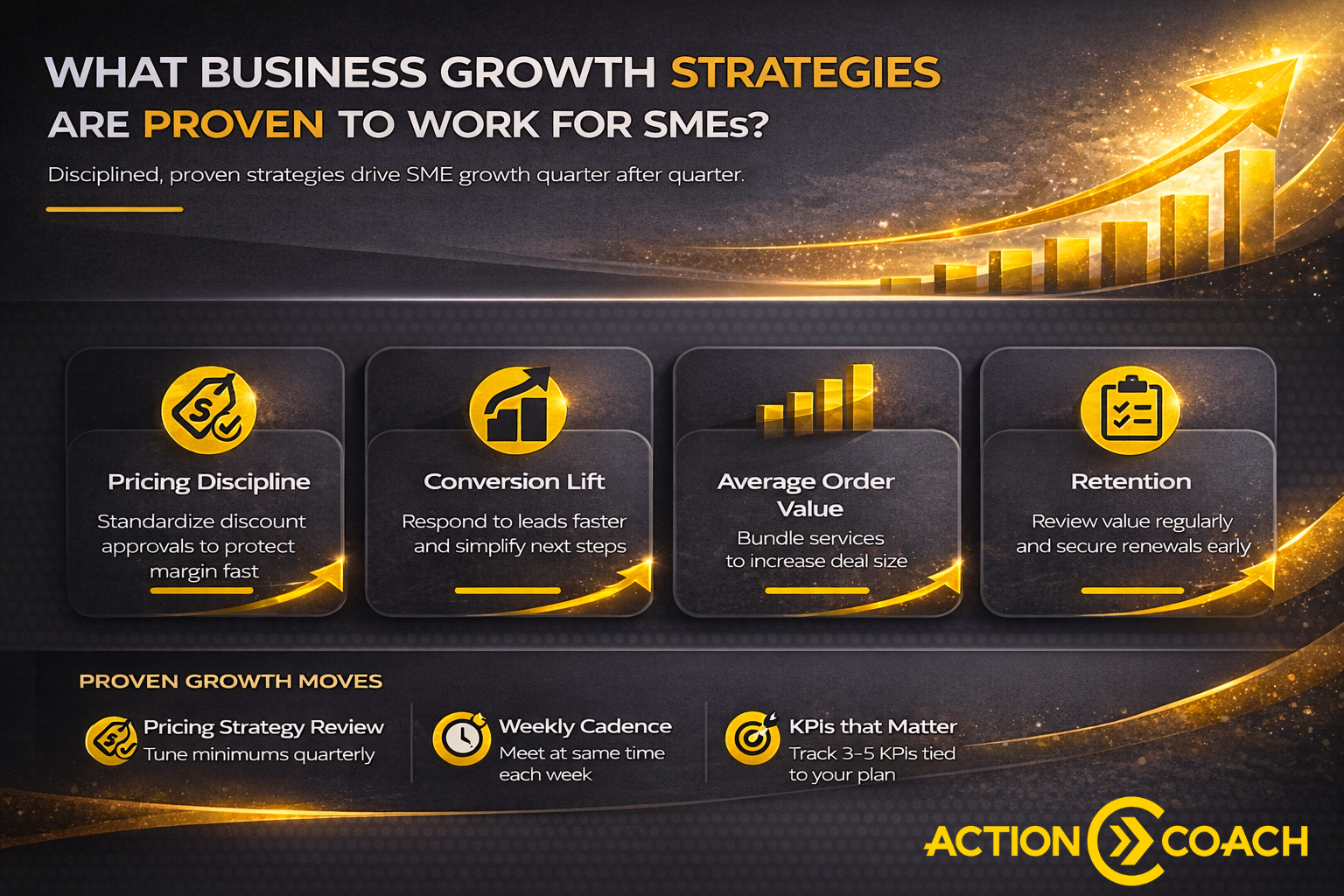
In SME reviews, these four levers show up again and again because they move the P&L without new headcount. The most reliable levers are:
- Pricing discipline: Standardise discount rules and approvals. This is one of the fastest business growth strategies to protect margin without extra spend. Keep approvals to same day. Metric: realised gross margin.
- Conversion lift: Speed and clarity win. Set response-time targets and give every opportunity a next step with a date. Metric: stage-to-stage conversion.
- Average order value: Present good-better-best proposals and bundle relevant add-ons. Metric: AOV and attach rate.
- Retention: Onboard with intent, review value on a schedule, and discuss renewal one quarter before term end. Metric: renewal rate or churn.
Review these levers monthly and keep one primary and one secondary for the quarter.
Want help choosing which lever to run this quarter? Review the planning workshops in Programs (tab 4).
How do I set growth targets and the right KPIs?
Pick three to five metrics that prove movement on revenue, margin, and retention. Choose KPIs that directly support your business growth strategies, so every number ties to an action. Examples: pipeline value, win rate, AOV, gross margin, renewal rate, and where relevant, cash days. Keep a one-page metrics view and show 8–12 weeks of trend lines. Balance leading and lagging indicators using the Balanced Scorecard lenses (Financial, Customer, Internal Process, and Learning & Growth) introduced by Kaplan and Norton. Tag each KPI to a lens so you can see gaps right away. If a KPI needs a paragraph to explain, drop it or rewrite it so a new manager can score it in ten seconds.
What weekly cadence helps growth show up?
Meet at the same time each week for 30 minutes or less. A fixed rhythm turns your business growth strategies into weekly actions. Review metrics, remove blocks, and confirm actions. Hold a week-six reset and adjust based on the data.
Checklist for every meeting: who owns it, what “done” means, when it is due, and where it sits on the dashboard.
Start on time, share the dashboard two hours before, capture actions live, and end with owners repeating their commitments.
See how the rhythm is set up in our planning workshops inside Education Coaching Program.
How can I improve pricing without losing deals?
Tie discounts to clear rules and coach value-led conversations. Set a maximum discount by role and keep approvals in hours, not days. Talk value before price. Log discount exceptions and reasons so you can coach patterns, not anecdotes.
Metrics to watch: realised gross margin and win rate on discounted deals.
Even small price moves can shift profit. In McKinsey’s model of typical company economics, a 1% price increase can lift operating profit by about 8% if volume holds steady. Clear discount rules and fast approvals protect that upside. Run a 15-minute pricing huddle every Friday: one exception you approved, one you rejected, and what the team learned.
Skill support: Coach your team for stronger value conversations with the DISC Workshop.
How do I increase sales conversion without more leads?
Speed and clarity improve close rates. As business growth strategies go, conversion lifts often beat new lead generation on time to revenue. Set response-time targets by channel. Add a next-step date to every opportunity. Use short templates for follow-ups. Reduce quote cycle time. Response time changes outcomes. In an HBR study of 2,241 companies, firms that contacted a lead within one hour were nearly seven times more likely to qualify than those that waited longer. Set a five-minute SLA for phone or chat and measure adherence on your dashboard. Route by channel: phone or chat aim for five minutes; web forms twenty minutes; email sends an auto-reply with the next step and a booked slot where possible.
Metrics to watch: stage conversion and quote-to-close cycle time.
How can I raise average order value (AOV) without pushiness?
Offer relevant bundles and tiered proposals. This business growth strategy helps buyers choose higher value without pressure. A simple good-better-best structure helps buyers choose. Add one logical upsell per core product and present it as added value, not pressure.
Metrics to watch: AOV and upsell attach rate.
Tiered Good-Better-Best proposals help buyers self-select higher value without pressure. Draft three tiers for one core offer this week: lock essentials in Good, place segment-critical value in Better, and reserve premium add-ons for Best. Put the most relevant value in “Better,” not “Best,” and price the jump so the middle tier feels obvious. Harvard Business Review’s coverage of Good-Better-Best pricing explains how well-structured middle tiers shift the mix without discounting.
Quick primer: Before you rebuild proposals, take the free course on packaging and margins.
What customer retention moves protect growth?
Onboard on purpose, review value regularly, and make renewal the default path. Retention is a core business growth strategy because it compounds revenue and margin over time. Schedule 30/60/90-day check-ins. Send brief value updates that tie work to outcomes. Start renewal talks one quarter before term end. Retention pays. Bain’s research, summarized in HBR, shows that increasing retention by 5% can raise profits by roughly 25% to 95%, depending on the model and cost base. Track renewal probability in the last 90 days of term and record a next action with a date for every at-risk account. In the last 60 days, switch to weekly touchpoints and track promise-to-pay or expansion notes alongside risk.
Metrics to watch: renewal rate or churn. Secondary: a simple health score or NPS where useful.
What should I stop doing to unlock growth?
Drop low-yield channels, long to-do lists, and meetings without decisions. Cut to three priorities for the quarter. Archive stale deals and focus on opportunities with a defined next action.
If an activity has not moved pipeline, margin, or renewal in eight weeks, park it. Growth shows up when you free time for the levers that pay. These business growth strategies take hold when you free capacity for focused execution.
How do I implement these business growth strategies step by step?
- Choose two growth levers for this quarter (for example, conversion and AOV).
- Select a short KPI set and name owners.
- Build a quarterly plan with a fixed weekly cadence.
- Write week-one actions in the room, assign owners, and log them where the team already works.
- Hold the week-six reset and refine based on the data.
- Repeat next quarter and keep trend lines visible.
Bring last quarter’s dashboard to the kickoff, even with blurred numbers; use the same structure so trend lines stay honest.
Turn Your Growth Plan into Measurable Results with ActionCOACH
You have the levers, the rhythm, and the KPIs. The gap now is execution keeping promises every week and resetting at week six.
If you want a plan you can run with your team and the accountability to keep it moving, Speak with an Advisor and map your top two business growth strategies into a 12-week plan with week-one actions.
