

Growth often starts to feel harder long before revenue or demand becomes the problem. In your business, the real friction often shows up when too many decisions, approvals, and fixes still end up with you. The business stays active, but momentum slows because too much still depends on one person.
That is usually when founder dependency starts to show. What built the business in the early stage now starts limiting it. More effort does not solve that. If you want to grow your business, the structure underneath has to carry more of the load. The business needs stronger decision-making below owner level and a structure that can carry growth without constant intervention.
At ActionCOACH, we often see this happen when growth outpaces decision structure. That is exactly where how business coaching works becomes relevant.
Why does owner involvement start to limit growth?
Your involvement usually becomes a problem when the business grows faster than the structure around it. You may still act as the safety net, but the volume of decisions and handoffs has already outgrown one person.
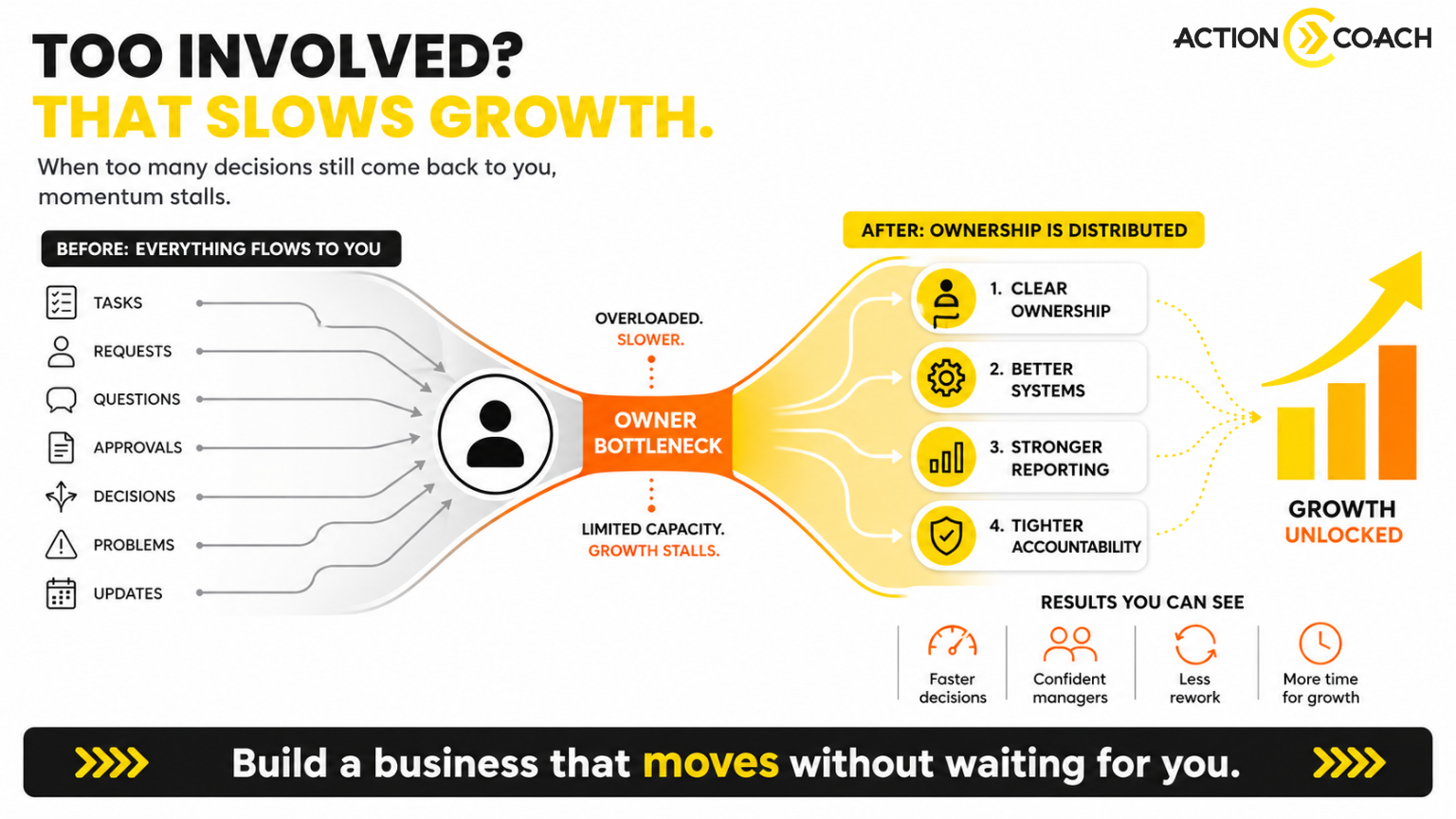
In the early stage, being hands-on often helps the business move faster. As your business grows, that same model starts to strain. More people need answers. More decisions get made every day. More work starts moving across departments, so delays show up faster. You can still try to stay involved in everything, but decision-making slows, approvals take longer, and you spend more time unblocking work than leading growth.
The business has outgrown owner-led control. That is often the point where you realise you cannot grow your business by staying at the centre of every decision.
What are the signs that a business owner has become the bottleneck?
This usually shows up before the owner fully recognises it as a problem.
You may notice that:
- managers keep bringing decisions back to you
- routine approvals still depend on your sign-off
- meetings move forward, but the same issues keep coming back
- people hesitate when you are not available
- progress slows when you take a day away from the business
- your week keeps filling up with work that should sit elsewhere
You may not spot the pattern straight away because staying involved still feels responsible. On the surface, it can still look like good leadership. In practice, it often means your managers are unsure what they truly own, decision rights are blurred, or too many standards still live in your head instead of the operating structure. That is often how founder dependency starts to show up in everyday decisions.
Left alone, these signs turn into slower decisions, hesitant managers, and more work drifting back upward than it should. That makes it much harder to grow your business in a controlled way.
Why do business owners stay too involved?
You probably are not staying too involved because you simply want control. In many cases, your business is still giving you reasons to stay close.
Standards may not feel secure yet. Your reporting may not give you enough visibility. Your managers may still need development. Decision rights may still be unclear. In some businesses, people have responsibility on paper but not the authority, confidence, or information to carry it properly.
That is why being told to delegate more is often lazy advice. If the structure underneath is weak, delegation fails quickly and the work drifts back upward.
Once reporting improves, ownership becomes clearer, and managers understand what sits with them, owner involvement usually starts to reduce in a healthier way. Control does not disappear. It just stops relying on constant oversight, which is exactly what helps you grow your business with less friction.
What needs to change if you want to grow your business?
To grow your business without staying trapped in the middle of everything, you need stronger operating discipline across the business.
That usually means:
- clearer decision rights so people know what they own
- better systems so work does not rely on memory or constant intervention
- stronger reporting so leaders can act with confidence
- tighter accountability so issues do not keep circling back
These changes matter because they stop your business relying so heavily on you. They also help you move into a different role. Instead of acting as the main approval point, you can spend more time on direction, commercial priorities, and the next stage of growth.
That shift helps the business make decisions faster, reduces rework, and gives managers more room to lead properly. It also gives you a stronger base to grow your business without everything slowing down around you.
How does business coaching help owners step back without losing control?
This is usually the point where outside support starts to help. Many owners already know they are too involved. The harder part is seeing exactly where that involvement is slowing the business down and what needs fixing first.
Business coaching helps you see where your involvement still adds value and where it now slows the business down. That usually means looking closely at decision rights, reporting quality, and the points where work keeps drifting back upward.
At ActionCOACH, that support is designed to help owners strengthen the business around them, not just push them to let go. Through one-to-one business coaching, owners can work through the real points of friction that keep slowing growth. Through wider coaching programs, they can find the right structure for the next stage.
The value shows up when decisions stop circling back, managers act with more confidence, and the owner stops stepping in just to keep work moving. That is when coaching starts to help you grow your business in a way that feels more stable and less reactive.
What happens when the owner stops sitting in the middle of everything?
The point is not to create distance. The point is to help the business move without everything funnelling back through one person.
When you no longer sit in the middle of every decision, the business usually becomes faster and more consistent. Your managers take more ownership. Decisions move with less delay. You get more time to focus on strategy, performance, and growth.
That does not mean you stop leading. It means leadership starts to work at the right level, with clearer handoffs and less escalation around routine issues.
When should a business owner get support?
Many owners wait too long because the business still looks active from the outside. The clearer signals show up in how work actually moves inside the business.
It is usually time to get support when:
- too many decisions still depend on you
- managers keep bringing issues back upward
- growth feels harder than it should
- your time keeps getting pulled away from strategic work
At that point, effort is not the issue. The business usually needs stronger structure, better accountability, and support that helps the owner stop acting as the default decision point. That support can make a real difference when you want to grow your business but cannot keep carrying every key decision yourself.
ActionCOACH’s Executive Coaching support helps business leaders make stronger decisions, reduce owner bottlenecks, and improve follow-through as the business grows. ActionCOACH’s 2 Weeks Free Coaching offer is also a practical way to explore what needs to change first.
Build a business that can move without waiting for you
You may reach a stage where hard work is no longer the issue. The issue is that your business still leans on you too heavily for decisions, approvals, and momentum.
That can be fixed, but not by asking you to simply step back and hope for the best. Growth becomes easier to manage when ownership is clearer, and managers carry more real authority. That is what allows you to grow your business without staying tied to every approval and problem.
ActionCOACH works with business owners who want a business that keeps moving even when they are not in the middle of every decision. To discuss the right next step, speak with an advisor.
