

Most training programs fail because they ignore how professionals actually learn.
I've spent three decades building businesses and training entrepreneurs. The traditional classroom-first approach doesn't work. It never has.
Here's what I discovered when we developed our training methodology at ActionCOACH. The problem runs deeper than poor content or boring presentations.
The real issue is identity.
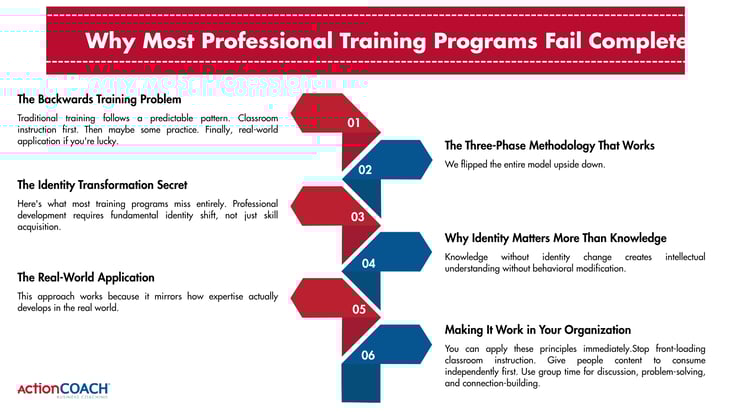
The Backward Training Problem
Traditional training follows a predictable pattern. Classroom instruction first. Then maybe some practice. Finally, a real-world application, if you're lucky.
This sequence violates how the brain actually processes and retains information.
When we commissioned research on educational effectiveness, the findings were stark. Most professionals forget 90% of classroom training within 30 days. The remaining 10% rarely translates into behavioral change.
The reason? They're learning information without context. Knowledge without identity transformation.
The Three-Phase Methodology That Works
We flipped the entire model upside down.
Phase One: Independent Content Acquisition
Before any group training begins, participants consume core content independently. Books, videos, workbooks. They build foundational knowledge at their own pace.
This isn't busy work. It's strategic preparation that allows the brain to form initial neural pathways without social pressure or time constraints.
Phase Two: Contextual Understanding
The 10-day intensive training phase focuses on connections, not content delivery. Participants already know the material. Now they discover how concepts link together and apply to their specific situations.
Group dynamics become powerful here. Peer learning accelerates understanding in ways individual study cannot achieve.
Phase Three: Practical Application
Real-world implementation with guided feedback. We call this "skinning the knees" because actual learning happens when theory meets reality.
This phase separates successful professionals from those who remain perpetual students.

The Identity Transformation Secret
Here's what most training programs miss entirely. Professional development requires a fundamental identity shift, not just skill acquisition.
I measure training success using the 80/20 rule. Successful participants integrate 80% new knowledge with 20% previous experience. They adopt our methodology as their primary professional identity.
Those who maintain 80% of their previous knowledge while adding only 20% new concepts typically struggle. They haven't made the psychological transition required for mastery.
The language test reveals everything.
When discussing business challenges, successful trainees say "we," referring to ActionCOACH. Struggling participants still say "we" about their previous company.
This linguistic shift indicates a complete professional identity transformation.
Why Identity Matters More Than Knowledge
Knowledge without identity change creates intellectual understanding without behavioral modification.
Think about it. You can teach someone every sales technique in existence. But if they still identify as "someone who's not good at sales," the techniques won't stick.
Identity drives behavior. Behavior creates results.
Our methodology engineers identity transformation through progressive knowledge building and community integration. Participants don't just learn new skills. They become different professionals.
The Real-World Application
This approach works because it mirrors how expertise actually develops in the real world.
Master craftsmen don't start with theory. They observe, practice independently, then work alongside experts who provide context and feedback.
Professional development should follow the same pattern.
Independent preparation builds confidence. Group training creates understanding. Real-world application develops mastery.
Each phase serves a specific neurological function that supports long-term retention and behavioral change.
Making It Work in Your Organization
You can apply these principles immediately.
Stop front-loading classroom instruction. Give people content to consume independently first. Use group time for discussion, problem-solving, and connection-building.
Create structured opportunities for real-world application with feedback loops. Don't just hope people will apply what they learned.
Most importantly, design for identity transformation.
Ask yourself: What type of professional are you trying to create? Then structure every element of training to support that identity development.
The goal isn't information transfer. The goal is to create professionals who think, act, and identify differently than when they started.
That's how you build training programs that actually change people.
Ready to train your team for transformation, not just information? Schedule a discovery call with an ActionCOACH and learn how this methodology can work inside your organization.
