

Effective leadership is the cornerstone of any successful organization. However, even the most seasoned best leaders can fall victim to common pitfalls that ultimately undermine their ability to build strong, united teams and drive sustainable growth. In this article, we will explore the top 20 common leadership mistakes that contribute to organizational dysfunction and failure to reach full potential.
By understanding these critical errors, current and aspiring business leaders may consciously avoid these pitfalls and lead their teams to new heights of productivity, innovation, and shared prosperity. By internalizing the timeless principles covered here, today’s new leaders will be enabled to steer their organizations to a brighter collective future. For an even further in-depth look into common leadership mistakes, download our free ebook, "Top 20 Leadership Mistakes" here.
Why is Leadership Important in Business?
Improving your leadership skills is critical to the success of any business. Here are some of the key reasons why the leadership position is so important:
- Sets the company vision and strategy: A leader takes responsibility for establishing a clear direction for the company, where it is headed, and how it will get there. This vision gives the entire organization a shared purpose and focuses all efforts.
- Builds team alignment: A strong leader brings together disparate individuals, unifies them behind the company vision, and creates alignment on objectives. This enables smoother execution.
- Motivates and inspires the team: Great leaders have high emotional intelligence to motivate employees, boost morale, and inspire peak performance. This drives higher productivity.
- Drives innovation and growth: Leadership establishes a culture of innovation that allows the company to continuously evolve and stay competitive. They also set growth strategies that expand market share.
- Manages change. Effective leadership helps the organization adapt to changing market conditions, new technologies, and other external forces requiring change management.
Ensures accountability. - Leaders create accountability to drive results: They implement the right KPIs, metrics, and incentives to keep the team focused on the company's strategic priorities.
In essence, leadership is the steering wheel that gives direction and enables smooth sailing towards the company's goals and full potential. Without effective leadership, any business is likely to flounder.
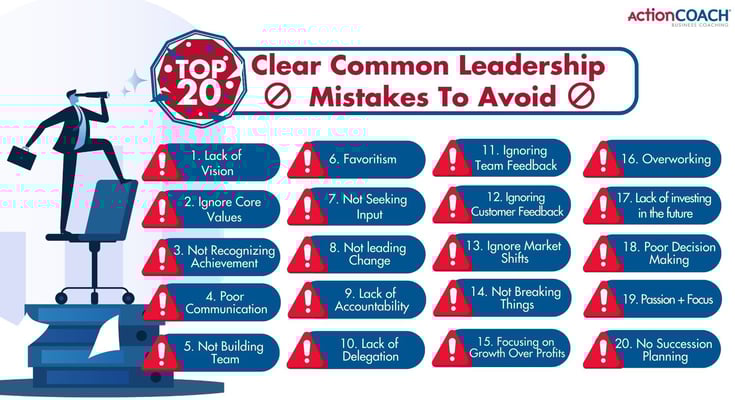
20 Common Leadership Mistakes
1. Lack of Vision
A common leadership mistake is failing to establish a clear, compelling vision for the organization. Where exactly are we trying to go? What is the desired future state in 1 year, 3 years, and 5 years out? Leaders know they must define and articulate an inspiring vision that gives direction, purpose, and a shared set of goals that energizes people. This vision serves as a north star guiding decisions and aligning all activities. Without it, efforts remain fragmented. Employees feel aimless rather than driven by a unified mission. Crafting an inspiring vision with a vivid description of the future state and goals to be attained is essential.
2. Ignore Core Values
Effective leaders want to cultivate strong organizational values and culture that give the company its unique identity. But often, many leaders make the mistake and fail to define the core values and principles that guide conduct and operations. What beliefs and behaviors does the organization stand for? Values powerfully shape decisions, customer perceptions, team cohesion, and achievement of goals. Clearly articulating detailed core values and exemplifying them through all communications allows customers and employees to become a living part of the organization’s culture. Lack of defined values leads to misalignment.
3. Not Recognizing Achievement
Leaders often do not acknowledge the achievements and efforts of their team members enough. Yet recognition is an immense motivator, validating people’s self-worth and boosting engagement. Leaders don’t need complex employee-of-the-month programs. Simple verbal recognition or a quick note goes a long way in making employees feel valued, driving further accomplishments. Failing to recognize achievements leads to declining morale over time. People feel their efforts are unnoticed or unimportant. But every leader can turn this around simply by praising wins, thanking people for their work, and celebrating successful projects. The personal touch matters.
4. Poor Communication
Leadership success hinges on effective communication. Yet many leaders who ignore this fail at being strong communicators. They may assume communication skills are innate rather than learned. But clear, inspiring communication that informs, aligns, and motivates teams must be consciously developed. Leaders think and assess their own level of communication skills and actively work to improve. Are our messages clear? Do people understand their priorities and goals? Are forums established for fluid bottom-up and lateral communication? Do people feel psychologically safe speaking up? Hone messaging and platforms until the organization has a transparent, smooth communications flow.
5. Not Building a Team
Leaders often hyper-focus on customers and growth while neglecting their most valuable asset, their team. But sustainable success stems from a skilled, aligned, high-performance workforce. Leaders must intentionally build up people's capabilities. Offer coaching and mentoring programs. Conduct training workshops for cross-skilled employees. Re-evaluate hiring practices to raise talent density. Create forums for coordination across departments. Enable people by removing roadblocks. Leaders who build their teams unlock far greater potential to then build the business. The output of a cohesive, talented team outpaces what any individual, including the leader, can deliver alone.
6. Favoritism
Leaders sometimes unconsciously play favorites by allocating opportunities, rewards, and face time based on personal relationships versus merit. But this destroys morale and trust fast. Employees lose motivation if they feel stuck while colleagues get unfair advantages unrelated to work contributions. Leaders must objectively recognize achievements and intentionally create forums that give equal visibility. A level playing field allows each person to contribute collaboratively to their full potential towards shared goals. Teamwork suffers when partiality emerges. Building an equitable culture of mutual understanding and respect enables the team to come together as a coordinated unit.
7. Not Seeking Input
Leaders often fail to actively seek input and feedback from their team members. Yet regularly collecting perspectives and ideas from staff on the frontlines is invaluable. Their insights, based on direct contact with customers, competitors, and day-to-day operations, provide precious real-time market intelligence. Leaders must swallow their ego, create psychologically safe forums for open sharing, actively listen, and prompt dialogue through regular touchpoints. If people's input is ignored, alienation follows quickly along with disengagement. But leaders who foster bilateral communication enjoy a strategic advantage through leveraging their team's collective eyes and ears.
8. Not Leading Change
The world moves fast, while organizations tend to be inert. Leaders either consciously disrupt and evolve the company over time to stay competitive or risk the market forcing unwanted crisis-mode change upon them. Leadership calls for constantly evaluating processes, customer needs, market signals, and spearheading proactive change initiatives before necessitated by external pressures. Leaders fail by only reacting versus anticipating and initiating change. They avoid messiness and hard calls rather than making minor course corrections routinely. Great leaders set goals and recognize that companies must keep learning, optimizing, and redefining themselves or fall behind. They lead change through experiments, innovation pipelines, and onboarding employee input on best upgrade paths.
9. Lack of Accountability
Leaders sometimes struggle to implement robust accountability systems that ensure work gets completed to required standards by designated deadlines. But setting clear expectations and following through with consequences is core leadership. Failing to make individuals accountable for delivering on responsibilities undermines productivity, causes friction for those pulling extra weight, and frustrates customers awaiting results. Leadership must frame accountabilities: who exactly is responsible for each business priority? How will completed work be verified through metrics and KPI dashboards? What rewards are there for exceeding or consequences for missing targets that will drive performance? Ongoing tracking of accountabilities transforms execution ability. Leaders who duck hard calls find that poor delivery persists.
10. Lack of Delegation
Many leaders fall into the trap of failing to delegate tasks and decisions, creating a bottleneck. By trying to control everything themselves, they become overwhelmed while depriving staff of empowering opportunities to harness their full potential. Effective leaders must consciously develop delegation skills, assigning meaningful responsibilities to others based on their strengths and growth needs. Training guides transfer of context and know-how. Gradual release of control is key, paired with support resources so people can execute independently. Failure to delegate kills innovation, overworks leaders while leaving great talent untapped. It stunts the organization. Master delegators understand that distributing ownership allows more ideas to flourish and frees their schedule to tackle higher-value work.
11. Ignoring Team Feedback
Leaders often ignore or dismiss input from their direct reports and staff. But closing themselves off to feedback cuts them off from invaluable intelligence. On the frontlines, employees have visibility into what’s working well or poorly across many areas of the business. Their insights spotlight gaps plus best practices to double down on. Their feedback paints a transparent picture of organizational health, including strengths, dysfunction, and real root issues. Wise leaders recognize this and establish recurring channels to collect input without ego. Regular pulse surveys, open office hours, and anonymous suggestion boxes reveal crucial perspectives otherwise hidden from view. Listening reflects humility and enables learning.
12. Ignoring Customer Feedback
Many leaders proclaim their customer obsession. Yet they fail to truly listen and incorporate customer verbatim feedback into shaping decisions and offerings. But customers hold the ultimate truth; their lived experience determines if a company delivers compelling value or dissatisfaction. Savvy leaders stay intimately connected to customer voices through ride-alongs, roundtables, surveys, online reviews, and more. They analyze patterns in feedback to pinpoint where the real problems and desires exist versus personal assumptions. Customer-derived insights then directly inform the company's innovation roadmap and everything from products to policies. Listening to customers, understanding their worldview, and translating this into action is the hallmark of strategic leadership today.
13. Ignore Market Shifts
Failing to detect major market shifts is a common leadership pitfall with catastrophic consequences. Disruptive startups and economic fluctuations can suddenly alter industry dynamics. Leaders who are over-confident or inward-looking completely miss game-changing transitions underway. But great leaders stay alert and attuned to external signals by continually engaging customers, analysts, and frontline staff to probe for subtle changes in preferences and buying criteria. They detect pattern breaks in metrics signifying deeper movement. Rather than denying or minimizing early signs of disruption, proactive leaders spot shifting sands early when still small. They rapidly realign offerings, messaging, and whole business models to reorient correctly to emerging customer needs and industry trajectories.
14. Not Breaking Things
Many leaders fall into complacency once their business model appears successful. They avoid messing too much with “what already works,” rather than continually stress testing and overhauling pieces to optimize. However, the world moves fast, and continuous rapid experimentation gives a competitive advantage. Leaders must foster a startup ethos within even large, established organizations. Pilot updated value propositions, alternate talent models, or AI automation to particular segments and quantify impact. Double down on what data proves delivers superior metrics. Challenge assumptions baked into operations continually by reinventing components. Leaders who incrementally break things learn deeply from controlled failure to drive innovation.
15. Focusing on Growth Over Profits
Leaders easily become seduced by topline growth numbers, chasing expansion often at the cost of healthy financial practices. Unmanaged growth stretches resources thin, however, increases expenses faster than revenue, and eats away profits over time. Scaling too fast or entering unvetted markets can hemorrhage money. Strong leaders pursue growth ambitions but are impatient of realizing profit. They expand judiciously after quantifying profit pools and establishing viable unit economics. Driving profitable growth involves saying no to chasing opportunities and doubling down where real margins exist. Leaders failing to keep profits centermost in growth decisions court disaster through enthusiasm-fueled bad financial decisions. Cash must keep pace with scale.
16. Overworking
Driven leaders often overwork themselves and fail to restore their energy. But leadership is a marathon requiring ample resilience. Likewise, excessive demands on employees’ time fuel quicker burnout. Leaders must consciously role model sustainable pacing through disciplined work schedules and behaviors. They should mandate regular vacations, discourage after-hours emails, and nurture workplace wellbeing. Renewal activities, self-care practices, and enforcing humane policies that honor people’s personal lives and needs for rest allow for sustainably high performance. Overworking backfires through attrition, ill-health, and poor decisions borne of exhaustion. Preventing fatigue preserves the engine’s power.
17. Lack of investing in the future
Short-term priorities dominate most leaders’ mindshare. But failing to also carve out time and budget for longer-term strategic investments handicaps the future. Leaders who narrowly react to present circumstances without planting seeds for the organization’s next chapter miss the bigger picture. Whether investing in training and development programs, R&D pipelines, exploratory pilots, or next-gen technologies, leaders must make tomorrow a priority today. They future-proof by building organizational capabilities, assets, and options that enable new directions as contexts shift. Rather than play catch-up, farsighted leaders who bank on the future have prepared talent, offerings, and infrastructure that lets them pivot and lead industry disruptions ahead of competitors.
18. Poor Decision Making
Many leaders who make mistakes trace back to poor decision-making practices. Leaders wing critical choices based on inadequate data, bias, or gut instinct versus robust fact-based analysis. Key decisions demand structured vetting of options against success factors to optimize outcomes. Leaders, hence, must hone their decision methodology through training and instituting companywide systems. For example, implementing post-action reviews assessing wins, losses, and lessons from past decisions improves future choice quality. Leadership founded on reasoned analysis, evidence collection, and mitigating cognitive blind spots sustains far better judgment over time and across issues. Instituting decision hygiene unlocks direction, problem-solving, and resilience.
19. Passion + Focus
Great leaders cultivate personal passion within their mission and channel this into sharp strategic focus throughout the organization. Mediocre leadership spreads resources thinly and then wonders why little gets achieved. But the best leader for your team is focused like a laser on priority goals and projects and is unstoppable. Their zeal attracts top talent equally inspired to create change. This high-commitment tribe then drives major outcomes through narrowing efforts only on what substantially moves the needle, versus getting distracted. Leadership having both fervent positivity about the future vision and disciplined attention on how to get there fast ignites teams through a contagious multiplier effect.
20. No Succession Planning
Leaders often only obsess about short-term growth, neglecting long-term sustainability. A key element of building an enduring organization, however, lies in succession planning. Leaders must envision the company’s future beyond themselves. They strategically mentor successors within the management team by handing off responsibilities gradually. Leaders who fail to develop replacements waste invaluable knowledge and know-how once gone. But consciously grooming the next generation of leadership ensures continuity, retaining cultural wisdom. The organization continues thriving into the founders’ retirement. Leaders focused singularly on immediate gains ignore their legacy. Preparing others to one day step into their shoes makes leaders immortal.

Conclusion
Leadership is a craft that must be honed through practice, humility, and structured systems to augment individual strengths. Prioritizing personal growth enables leaders to bring out the best in those around them. While the road ahead will not be smooth, conscious leadership paves the path towards shared prosperity by putting people first and pursuing progress the right way. For even more details on how you can avoid these leadership mistakes, download our free ebook "Top 20 Leadership Mistakes" here and watch your leadership skills soar to new heights.
FAQ's
1. What are the most common leadership mistakes?
The most common leadership mistakes happen when they are failing to set a clear vision and strategy, poor communication and team building, not seeking input, ignoring market shifts, and failing to succeed. Effective leaders avoid these critical errors.
2. Why is a clear vision important in leadership?
A compelling vision outlines the future goal and rallies all employees behind a shared mission to work towards. It focuses efforts and drives engagement.
3. How can leaders improve their communication skills?
Leaders can develop communication skills through training, designating channels for fluid information flow, and actively listening without ego to understand diverse perspectives.
4. How should leaders drive innovation in their company?
Driving innovation requires investing in R&D, running small experiments to test new concepts, incentivizing ideation across teams, allowing some failure, and fostering an agile, creative culture.
5. What is an important element of strategic leadership?
Strategic leaders anticipate market transitions before they happen by continually engaging staff and customers to detect subtle shifts. This foresight enables proactively evolving the business model.
