
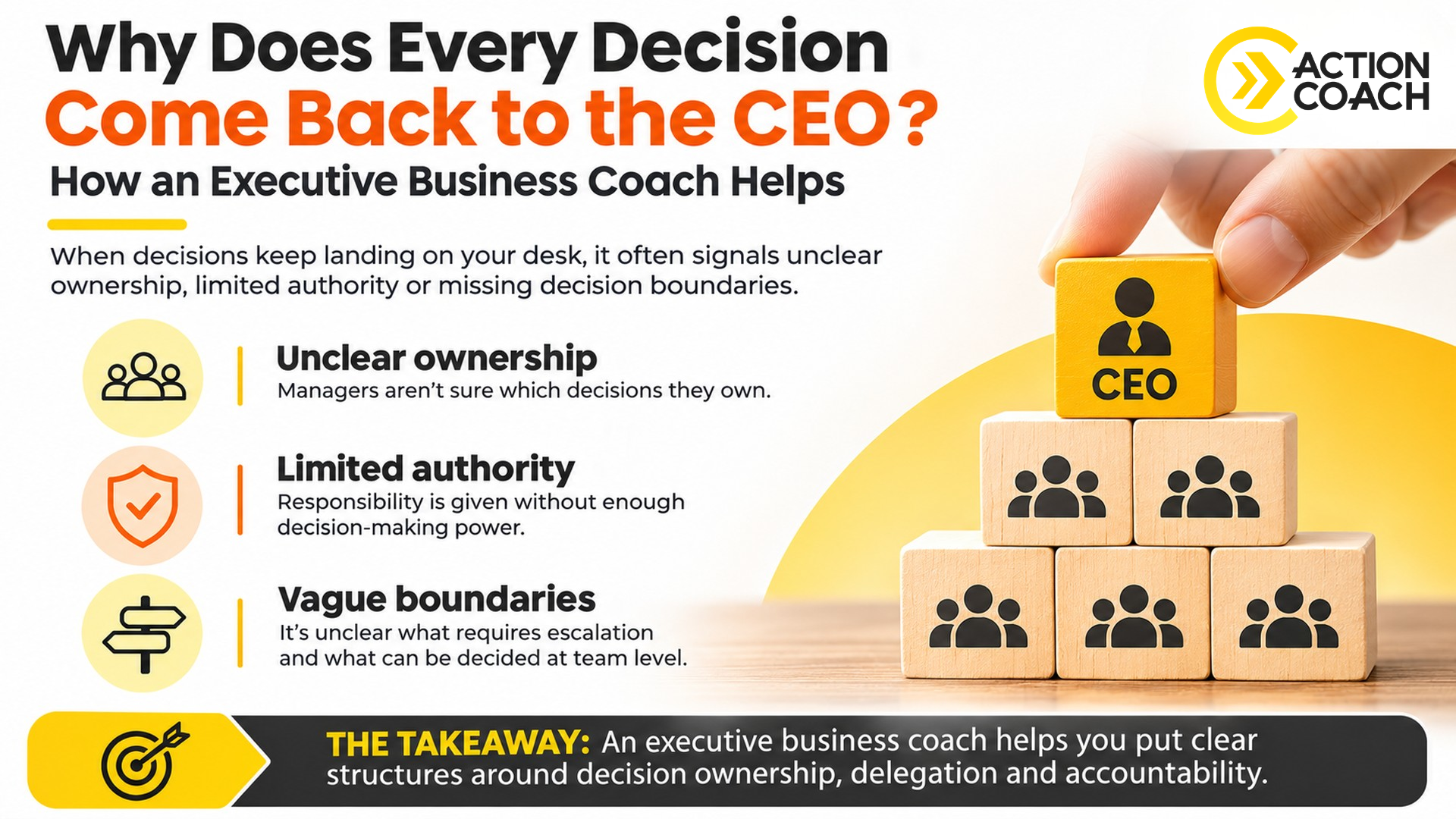
If you're a CEO and routine decisions keep landing back on your desk, the business may have outgrown the way decision-making is structured. Managers can carry responsibility without enough authority, teams may lack the information to act confidently, and escalating upwards can become the safest option. The result is slower execution and less CEO time for strategy, leadership and growth.
That is where an executive business coach can help. A coach can identify where that dependence is being created and put clearer structures around decision ownership, delegation and accountability. The goal is not to remove the CEO from important decisions. It is to make sure decisions are made at the right level, while preserving senior oversight where it genuinely matters.
Why do decisions keep coming back to the CEO?
In short, decisions tend to return to the CEO when responsibility has spread faster than the authority, information and accountability needed for other leaders to act confidently.
- Decision ownership is unclear. Managers are responsible for an outcome but do not know which decisions they actually own.
- Authority stops short of responsibility. People can manage the work but still need approval to make meaningful changes.
- Decision boundaries are vague. Teams do not know which financial, operational or risk thresholds require escalation.
- The right information is not available at the right level. Managers may lack the KPIs or operational data they need to make a confident call.
- Leadership capability is still developing. Greater authority sometimes needs to be matched with coaching, experience or management development.
- Old operating habits remain in place. A CEO who made most decisions when the company was smaller can remain the default decision-maker long after the organisation has grown.
When several of these gaps appear together, working with an executive business coach becomes practical. ActionCOACH's One-to-One Coaching combines a strategic roadmap with a focus on systems, teams, time and accountability. Applied here, that means identifying where decisions repeatedly return to the CEO, clarifying ownership and creating boundaries that allow leaders to act with greater confidence.
What are the signs that your business relies too heavily on the CEO?
Over-reliance on the CEO usually shows up in the way work moves through the business. Decisions that should sit with managers are repeatedly pushed upwards, projects pause while teams wait for approval, and relatively routine issues end up competing with strategic priorities for the CEO's attention.
Another sign is hesitation among otherwise capable managers. They may understand what needs to happen but still feel unable to act without checking first. Sometimes the problem is authority; elsewhere, it is access to information or uncertainty about how much risk they are expected to take.
You may also notice that the same types of decisions keep returning to you. Supplier changes, pricing exceptions, hiring decisions or operational adjustments repeatedly require CEO input even though similar situations have been handled before. That pattern suggests the business has not yet translated experience into clear decision rules or ownership.
Taken together, these patterns leave leadership capacity concentrated at the top. As the company grows, that becomes harder to sustain because the CEO's time is still being absorbed by decisions that could increasingly sit elsewhere in the organisation.\
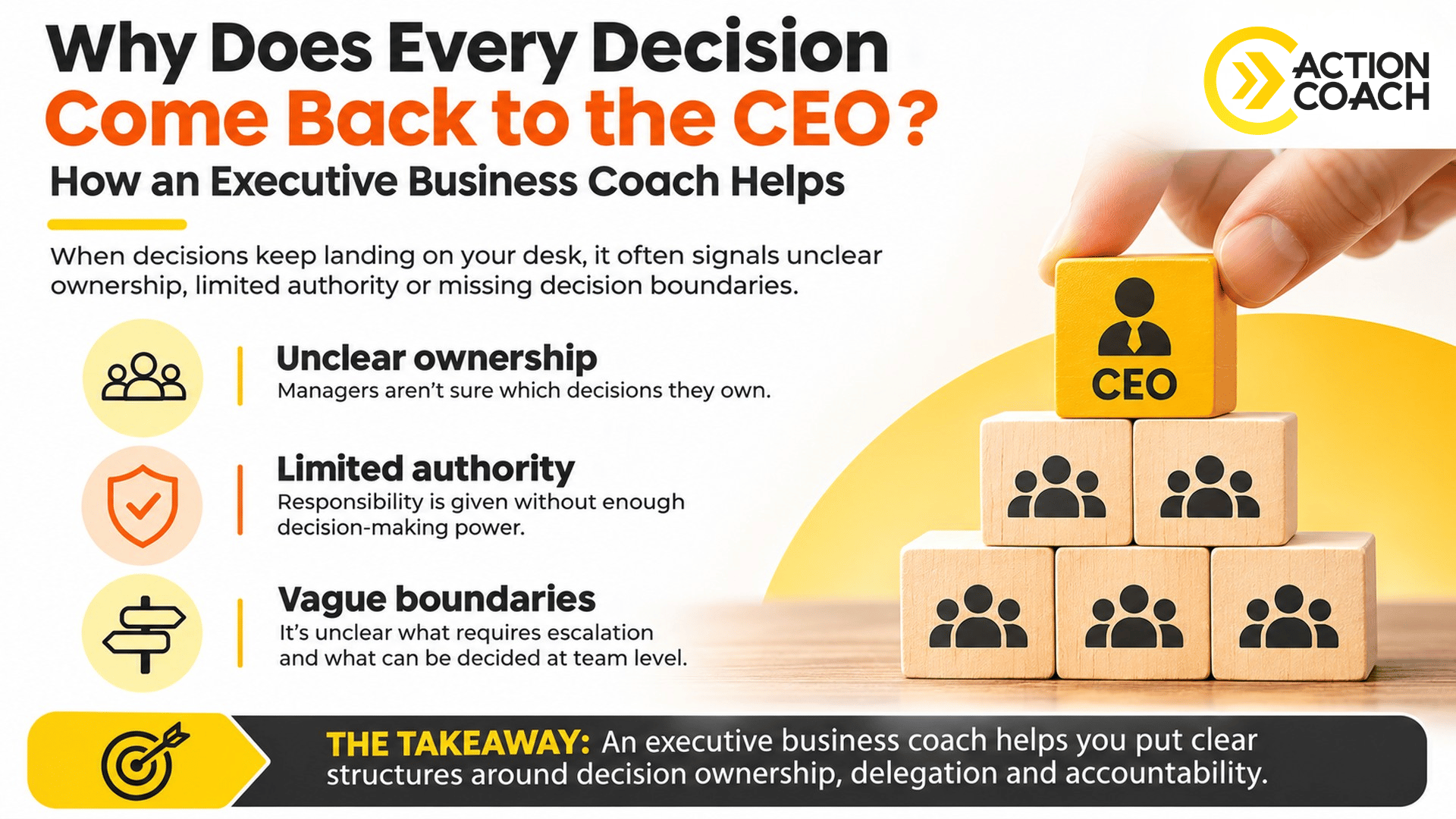
How do unclear decision rights push more decisions back to the CEO?
Managers are far more likely to escalate a decision when they are unsure where their authority begins and ends. Giving someone responsibility for a team, budget or function does not automatically tell them which decisions they can make independently.
Consider a manager dealing with a supplier change. They may know the commercial case is sound but still be unclear about whether they can approve the cost, whether switching suppliers creates a level of risk that requires senior oversight, or whether another department needs to be consulted first. Escalating to the CEO becomes the safest response.
The same thing happens when different teams interpret "material" decisions differently. Different departments may operate with very different assumptions about what requires senior approval. Without agreed thresholds or escalation rules, decision-making becomes dependent on precedent, personal confidence or whoever happens to be available.
For that reason, clear decision rights matter. They establish who owns the decision, what limits apply and which circumstances require escalation. Managers gain room to act, while the CEO remains involved where the financial, strategic or operational consequences genuinely warrant it. These are also the kinds of boundaries an executive business coach can help a leadership team clarify.
Why does delegation fail when managers still need CEO approval?
Delegation fails when managers are given responsibility without the authority, information or support to make decisions independently. Passing on a task is not the same as transferring ownership of the decision that sits behind it.
That is why authority and boundaries need to travel together. Managers should know which decisions they can make, what limits apply and when a call genuinely needs to be escalated. Without those guardrails, checking back with the CEO can feel safer than acting.
Clear boundaries alone are not enough. Teams also need timely, useful information and enough capability to interpret it. Relevant KPIs and operational data reduce guesswork, while support from an executive business coach or targeted leadership training can strengthen decision-making where responsibility has expanded faster than experience.
Accountability then closes the loop. Decisions should be reviewed against outcomes so teams can learn what worked, where judgement needs to improve and whether the boundaries need adjusting. Without that review, the CEO can be pulled back into operational questions and decision-making slows across the business.
What does effective decision-making look like without constant CEO involvement?
Once ownership is clearer, the next step is to make the structure work day to day. That means aligning decision rights, information flow and governance so people can act with confidence:
- Map decision rights. Create a simple decision rights matrix that identifies who decides, what information is needed, and what approvals are necessary at each level.
- Define escalation rules. Establish transparent rules for when a decision must rise to the senior team or board, and when it can stay at a departmental level.
- Create decision-ready information. Ensure teams have dashboards, KPIs, and the right data views to act confidently without endless cross-checks.
- Build capability. Provide coaching and training to strengthen leadership capability at middle management, so they can execute decisions effectively.
- Establish a feedback loop. Regular review of decisions and outcomes helps refine ownership and accountability.
In practice, this creates a decision structure where routine matters no longer need to keep returning to the CEO. Managers know what they own, when to escalate and which information should guide their decisions.
How can an executive business coach reduce dependence on the CEO?
An executive business coach can help reduce CEO dependence by identifying where authority, information or accountability breaks down and turning those findings into a structured plan. In practice, that can include:
- Clarify decision ownership so managers know which calls they can make and which genuinely require CEO involvement.
- Define escalation thresholds around financial, operational or strategic risk so decisions do not rise upwards by default.
- Improve access to decision-ready information, including the KPIs and operational data leaders need to act confidently.
- Strengthen leadership capability where greater authority needs to be matched with experience, coaching or management development.
- Keep implementation moving through ongoing accountability, agreed milestones and regular review.
ActionCOACH's One-to-One Coaching brings a strategic roadmap and ongoing accountability to that work, helping leaders move from diagnosis into implementation. The focus remains practical: clearer priorities, stronger systems and a leadership team that can take greater ownership without losing alignment with the CEO.
How can CEOs redistribute decision-making without losing control?
If you recognise this pattern in your organisation, the most useful next step is to turn the diagnosis into a workable decision structure. A practical starting point is to work through the following steps.
- Diagnose quickly with a simple decision-rights exercise. Create a map that shows who decides what, what information is needed, and where escalation occurs. Include high-impact areas such as financial approvals, major supplier changes, and strategic initiatives.
- Clarify the boundaries. Agree a set of non-negotiables that the CEO retains (for example, strategic direction and risk oversight) and identify decisions that can move to leadership teams and departments.
- Establish governance cadences. Schedule regular decision reviews where teams present outcomes and learnings, not just actions completed. Use dashboards to track progress against KPIs tied to decisions.
- Invest in capability development. Offer targeted leadership development and coaching to managers who will assume more decision-making responsibility. The aim is to raise confidence and capability, not merely offload tasks.
- Create an accountability framework. Connect decisions to measurable results, with follow-up on outcomes and adjustments where needed.
Done well, this does not remove the CEO from important decisions. It creates more time for the highest-value work by moving appropriate decisions closer to the people responsible for them. An executive business coach can help reallocate that effort so leadership focus stays on the judgement calls that genuinely require senior attention.
When is it worth working with an executive business coach?
Working with an executive business coach becomes particularly useful when the same decisions continue to return to you despite attempts to delegate, or when the cause is difficult to isolate from inside the business.
- Managers have responsibility for outcomes but still seek CEO approval before acting.
- Leadership meetings are repeatedly dominated by operational escalations rather than strategic priorities.
- Previous attempts to delegate have changed who owns the task, but not who is expected to make the decision.
If CEO dependence appears to be part of a wider operational problem, the ActionCOACH Business Operating System (ABoS) offers a broader diagnostic view. Its 184-question assessment and personalised dashboard examine areas including operations and team performance before a focused 90-Day Action Plan is developed.
What should a CEO do if too many decisions still depend on them?
Start by mapping the decisions that repeatedly return to you. Separate the calls that genuinely require CEO judgement from those that could sit elsewhere with clearer authority, information or boundaries. From there, an executive business coach can help you test the new ownership model on one or two recurring decision types before expanding it more widely.
The aim remains the same: preserve CEO involvement where it adds the most value while building enough clarity and capability elsewhere for other decisions to move forward without unnecessary escalation.
If the same decisions continue to return to you, or you want structured support to redesign how responsibility and accountability work across the leadership team, find an ActionCOACH business coach.
