

When it comes to personal and company growth strategies, there’s no magic bullet. Every business has its unique quirks and challenges, and that’s what makes the journey exciting.
So, how do you take your business to the next level?
I, Brad Sugars, founder of ActionCOACH, have spent over 20,000 hours in the trenches of business success. Today, I’m sharing the insights and strategies that have helped countless businesses thrive. We’ll cover everything from nailing success to mastering the formulas of business marketing and boosting your profits through a comprehensive growth strategy. Remember, the best growth strategy is the one that fires you up and fits your business like a glove.
Ready to turn that fear into fuel for excitement?
This growth plan is sure to redefine your approach. Dive into these effective growth strategies and get ready to dominate your market. Don’t wait—watch the video, act now, and start making those game-changing moves today to get your business ready for new heights!
How to Achieve Success: Our Growth Strategy
"Dreams times goals times learning times plans times actions equals success." This isn’t just a catchy phrase—it’s the formula for building success by building yourself, especially when it comes to executing key growth initiatives. Below, we’ll dive into how you can harness this powerful equation to achieve both personal and business growth.
Dreams Dreams are the fuel that drives us towards a desirable future. If you don't have dreams, you’re settling for average goals, and average goals lead to average results. Aim higher! Set dreams that are so big they almost scare you. Think 10 years into the future and how growth strategies can help shape it. Your dreams should be so audacious they serve as a compass, guiding you towards greatness.
Goals
Now, let's break those dreams down into actionable goals. Your five-year goals should be clear and ambitious. But the magic happens in the daily grind. Set daily goals that align with your weekly, monthly, and yearly milestones. If you achieve your daily goals, you'll naturally hit your weekly targets, contributing to the overall growth strategy. This momentum will build into quarterly and yearly success. Look to role models who’ve achieved your dreams and mimic their actions and habits. This will help you create goals closer to your ultimate dream.
Learning
Setting goals is just the beginning. The real challenge lies in figuring out how to achieve them. Ask yourself, “What do I need to learn to accomplish this goal?” This step is crucial. It involves changing your daily habits, reading the right books, consuming the right content, and developing a learning plan that propels you forward. Continuous learning is the cornerstone of growth.
Plan
Planning is where you turn your learning into action. Break your long-term goals into smaller, manageable pieces. Ensure each step aligns with your overall growth strategy. If your five-year goal is ambitious, what should your situation look like in two and a half years? Consider a market development plan to stay on track. Break it down further—what do you need to achieve each year, each month, and each day to stay on track? Focus on small, incremental steps that build up to larger achievements. This method keeps you focused and motivated.
Act
Finally, it's time to act. Your daily actions are the building blocks of your success. Small, consistent steps create momentum, leading to significant breakthroughs in your growth marketing strategy. Remember, change starts with you. By taking inventory of your dreams and goals, devising a learning plan, and acting on it daily, you’re setting the stage for monumental success. Change your mindset, change your life.
Ready to take the first step? Watch our video now and start implementing these new business strategies today. Your future self will thank you!
6 Top Growth Strategies For Any Business
Unlocking the secrets to skyrocketing your business growth doesn't have to be daunting. Below, we’ll provide blueprints and formulas for different revenue growth strategies that can transform your business, including market development and organic growth techniques. The most successful strategy is the one that resonates with you and can be practically applied to boost your bottom line and drive profitable growth.
The ultimate aim?
Creating a business that thrives independently, profitably acquiring lifetime customers who become raving fans and drive your profit growth. Don’t let the fear of failure hold you back. Be excited to learn, grow, and implement the right growth strategy for your business. Embrace your true potential and watch your business soar.
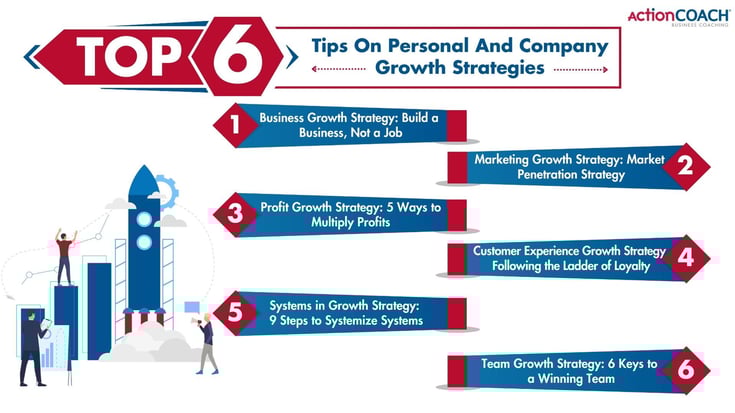
1. Business Growth Strategy: Build a Business, Not a Job
A business is a commercial, profitable enterprise that works without you. To truly succeed, you need to become a better business owner, not just better at the job within your business. To achieve this, you need to master four key areas. Each level of mastery requires you to answer two essential questions: 'What?' and 'Why?'
Destination
What do you want out of your business? This requires careful planning to bring clarity to your vision. Start by defining your company’s vision, mission, and goals using a growth strategy to ensure internal growth. Business goals should be ambitious and actionable, broken down into daily steps that lead to your ultimate dream. Much like personal goals, business goals should be specific, measurable, and time-bound to help your business.
Time
Time management isn't simply about managing time; it's about managing yourself. Business owners who excel in self-management can dramatically increase their productivity. With 52 weeks in a year, every moment counts towards realizing your business objectives. The more efficiently you manage your time, the more you can focus on planning and achieving your business dreams. The ultimate goal is to create a profitable enterprise that operates independently of your daily involvement.
Delivery
Consistency is crucial for business growth. Establishing reliable processes for your products or services ensures consistent delivery. By leveraging these processes, you create a system that requires minimal oversight. This sets up your business to be a commercial, profitable enterprise that can run smoothly without your constant input.
Financial
Mastering your finances is essential for profitability. In addition, understanding your numbers is vital to establishing and maintaining a profitable business. This involves constant measuring and testing, particularly in your marketing efforts, to ensure your growth marketing strategy is effective. If you can't measure your business's progress against its goals, you won't be able to achieve your dreams. Financial mastery involves knowing the key metrics that drive your business's success and using them to guide your strategy.
2. Marketing Growth Strategy: Market Penetration Strategy
When it comes to growing your business, a solid marketing strategy is crucial. The goal isn’t just to attract any customers but to acquire loyal, lifetime customers who keep coming back. To achieve this, you need to penetrate your market effectively by focusing on what makes your business unique and delivering unparalleled value.
Let's dive into how you can implement a market penetration strategy that sets you apart from the competition and drives long-term growth.
Identify Your Niche
It’s essential to market to a niche to enable new business opportunities. Competing on price alone is a race to the bottom. To avoid price competition, your business must offer a unique selling proposition (USP). What sets you apart from others in your industry? One effective method is to provide a guarantee. As I’ve always said, “By law, you have to guarantee what you sell anyway, so why not turn it into a marketing initiative and actually get more business from it?” This strategy not only differentiates you but also builds trust with your customers.
Stand Out with a USP
Your unique selling proposition should highlight what makes your business special. It could be superior quality, exceptional service, or a guarantee that offers peace of mind. Whatever your USP is, it needs to be clear and compelling. Incorporate a marketing and business growth perspective to differentiate effectively. Consistently delivering on your USP will help you carve out a distinctive place in the market and avoid competing solely on price.
Focus on Customer Service
Excellent customer service is a daily goal that can establish you firmly in your existing market share. Make every customer interaction count to attract a new customer and drive organic growth. Happy customers become repeat customers and advocates for your brand. They are your best marketing tool. Focus on exceeding expectations and turning every customer into a loyal, lifetime customer.
Leverage Multiple Growth Strategies
Your marketing growth strategy should include multiple methods tailored to your unique business. If you don’t leverage your unique selling points, someone else in your niche will, and they’ll outpace you. Growth levers for your business could include content marketing, social media engagement, email campaigns, and more. Take the time to fully analyze your business and understand your USPs to create a solid growth hacking strategy.
Analyze and Adapt
Continually analyze your marketing efforts and adapt your strategies. Marketing and business growth should be aligned to maximize effectiveness. What’s working to facilitate profitable growth? Understanding these elements can refine your growth strategy. Using data will inform your decisions and fine-tune your approach. Staying agile and responsive to market changes will keep you ahead of the competition.
3. Profit Growth Strategy: 5 Ways to Multiply Profits
In this phase of our business growth strategy, we’re focusing on five key areas: Leads, Conversion Rate, Number of Transactions, Average Sale Value, and Margins. As you optimize these areas, you can significantly boost your profits.
Here’s how to make it happen:
5 Ways to Multiply Profits
Our profit formula is straightforward:
Leads x Conversion Rate = Number of Customers. Add new strategies to increase leads or improve conversion rates to boost your growth.
Number of Customers x Number of Transactions x Average Sale Value = Revenue
Revenue x Margins = Profits
The average business owner might have two lead generation strategies, but we aim for seven. Expanding your lead generation efforts opens up new avenues for customer acquisition.
Conversion Rate
There are 83 strategies to improve your conversion rate. By implementing a few of these, you can turn more leads into paying customers, expanding your business significantly. Focus on refining your sales process and customer journey.
Number of Transactions
With 78 strategies to boost transaction rates, you can encourage customers to buy more often. Loyalty programs, follow-up sales, and subscription models are just a few ways to increase the frequency of purchases within your growth marketing strategy.
Average Sale Value
There are 59 strategies to increase the average value of each sale. Upselling, cross-selling, and bundling products can help you maximize the value of each transaction.
Margins
Improving your margins involves 56 different strategies. Reducing costs, negotiating better deals with suppliers, and optimizing your pricing strategy can enhance your profitability as a part of a comprehensive growth strategy. Examples of growth strategies might include expanding into new markets or developing new products.
Implementing Multiple Strategies
As you apply three to four strategies in each category, such as an acquisition strategy or organic growth tactics, you can multiply your profits within twelve months. It's about consistent, focused effort in these key areas.
Quick Wins: Two Methods for Immediate Impact
-
Measuring and Focusing: Simply measuring your performance in these areas can reveal where you can increase efficiency and find room for growth. Shift your focus to these metrics and watch for areas of improvement.
-
Fixing What’s Already Implemented: Sometimes, you don’t need more marketing. By fixing and optimizing your current strategies, you can uncover issues and make significant improvements. Regular measurement and adjustment are key to this process.
As you work on these five ways to achieve growth, you can boost your business revenue and reach your goals and dreams faster. Develop your core business profits with our sustainable growth strategy and see positive results.
4. Customer Experience Growth Strategy Following the Ladder of Loyalty
Let's talk about the Ladder of Loyalty—a powerful tool to transform casual shoppers into raving fans. Here’s how you can use it to boost your customer experience and drive growth.
Suspect: At the bottom of the ladder, we have suspects. These are individuals in your target audience who haven’t yet engaged with your business. Your goal here is to attract their attention and make them aware of your offerings.
Prospect: A suspect becomes a prospect when they show interest—when they raise their hand or identify a problem you can solve using an acquisition strategy. This stage is all about capturing their interest and providing solutions.
Shopper: When a prospect makes their first purchase, they become a shopper. This initial transaction is critical—it’s your first opportunity to impress them with your products and services.
Customer: A shopper turns into a customer with their second purchase. Customers are familiar with your process and have had multiple transactions with you. They trust your business enough to come back.
Member: When customers start feeling like they belong, they become members. This might involve joining a loyalty program or membership scheme, which can also serve as a market development tactic at the end of your growth strategy. It’s about creating a sense of community and belonging.
Advocate: Members who bring referrals to your business become advocates. They actively promote your brand, telling their friends and family about you. This word-of-mouth marketing is incredibly valuable for market development.
Raving Fan: Advocates who go above and beyond—bringing multiple referrals, posting on social media, and boosting your marketing efforts—are your raving fans. They are crucial to your strategic growth initiatives. Examples of this growth strategy might include partnerships with another company or diversifying your product line. They generate more profit for your business than any other group.
Maximizing Loyalty: Raving fans and advocates are your most valuable customers. You need to know them by name, have a dedicated plan for them, and handle them with great care, as part of your winning strategy. The potential for growth is immense if you can effectively nurture and maximize this loyalty. Your growth goals are only limited by your knowledge and ability to implement best practices in customer experience. Deliver results for the business by continuously learning and adapting.
5. Systems in Growth Strategy: 9 Steps to Systemize Systems
As the owner and CEO, your job is to build the systems, the systems run the business, the team runs the systems, and you lead the team, bringing the system full circle. Let's dive into the nine essential steps to systemize your business for growth.
Steps to Systemize Systems
-
Vision: Start with a clear vision. Understand the direction you want your business to head, employing internal growth strategies to get there. Your vision is the foundation for everything else.
-
Mission: Define your mission. This outlines your business's purpose and the value you provide. A strong mission keeps your team aligned and motivated.
-
Culture/Values Document: Establish your culture and values. This document guides behavior and decision-making, ensuring everyone is on the same page. It supports the internal growth strategy and helps build a strong, cohesive team.
-
Goals: Set clear, achievable goals. You cannot build a system until you understand the objectives you're aiming for. Goals give your team a target to strive toward.
-
Organizational Chart: Create an organizational chart. This visual representation of your business structure clarifies roles and responsibilities. It’s the blueprint for your team.
-
Position Contracts: Develop position contracts. These documents outline what each role entails and the expectations. They provide clarity and accountability for every team member.
-
Key Performance Measures: Identify key performance measures (KPIs). These metrics track progress and performance. KPIs ensure that everyone is aligned with the business goals, mission, and key growth areas.
-
How-to Manuals and Training Videos: Develop how-to manuals and training videos. These resources are essential for consistent performance. They provide detailed instructions and training to ensure everyone knows how to perform their duties effectively.
-
Checklists: Implement checklists. They ensure that tasks are completed correctly and consistently. Checklists are a simple yet powerful tool to maintain high standards.
Building a system that runs without you takes time and dedication. You need to understand all the components of your winning business growth strategy. Do the work once and get paid forever. Systemize your business to build a commercial, profitable enterprise that can operate independently.
6. Team Growth Strategy: 6 Keys to a Winning Team
Team: Together, Everyone, Achieves, More.
You, as the owner, have to build your team to help your business. The way you take care of your team is how your team takes care of your customers, how your customers take care of the business, and how the business takes care of you. Growth requires a focus on both employee satisfaction and customer experience. This interconnected relationship is part of your winning strategy.
1. Strength of Leadership
First and foremost, your team needs strong leadership. As a business owner, you must invest in leadership training for yourself and your team members. Effective leaders inspire and guide their teams toward success, setting the tone for the entire organization.
2. Common Goal
Everyone on your team needs to know where the business is heading. Establish a common goal that benefits everyone involved. This shared vision aligns your team’s efforts and motivates them to work together toward a unified objective.
3. Rules of the Game
Set clear rules of the game to create room for growth within your team. This includes establishing policies and conducting business professionally. Your team needs to understand the standards and expectations to maintain consistency and professionalism.
4. Action Plan
Develop a detailed action plan. Break down your business goals into daily actions for each team member. These daily tasks should contribute to reaching your quarterly goals and creating a clear path to success.
5. Risk Taking
Encourage risk-taking. Innovation often involves taking risks and making mistakes. Support your team members when they step out of their comfort zones. Understand the difference between making a mistake and engaging in bad business practices. Foster an environment where calculated risks are welcomed.
6. 100% Inclusion and Involvement
Ensure everyone on your team is included and involved. A winning team is one where everyone feels they are part of the journey. Engage all team members in the business’s growth strategy so that everyone is on the same page and working towards the same goals,
The goal is to build a championship team. Championship teams never stop training and thrive on massive amounts of communication. The hardest part of leadership is continuous learning and growth, which requires a comprehensive growth strategy. Take the time to develop your personal leadership skills, become the catalyst for team growth, and lead by example. Together, everyone achieves more. Start today by investing in your team’s growth and watch your business reach new heights.
Ignite Your Growth: A Roadmap to Business Success
In this blog, we delved into top growth strategies for achieving business success. We've explored everything from the formula to achieve success and the business growth plan process to marketing strategies focusing on profits, customers, and team development. These insights are designed to equip you with the skills and knowledge I've developed from helping countless business owners find their path to growth and success.
Start with your dreams and goals, whether personal or business-oriented. A growth strategy is a plan that helps you achieve these goals. These goals serve as your compass, guiding your future plans and shaping the daily actions you need to take to achieve them. Remember, the most important change starts with you. Identify areas of uncertainty and confusion, and use the wisdom provided by ActionCOACH to bring clarity and confidence to your growth strategy.
Lean on decades of experience and request a free discovery call to speak to an ActionCOACH who can walk you through any portion of what you’ve read today. They can cater to your unique situation, helping you unlock your true potential and achieve your dreams. Your journey to success starts now—take the first step and ignite your growth with a solid growth strategy!
FAQ's
1. What are the key pillars of an effective growth strategy?
The key pillars of a growth strategy include understanding your target audience, defining goals and key metrics, developing unique value propositions, allocating resources effectively, embracing innovation and iteration, and focusing on sustainable long-term growth over short-term wins.
2. How can I come up with ideas for new growth opportunities?
You can come up with growth strategies for your business opportunities by deeply understanding customer pain points, optimizing sales funnels, seeking adjacent markets ripe for disruption, exploring diversification opportunities, analyzing macro trends and industry shifts, surveying existing users, and brainstorming ideas without limiting constraints initially.
3. What role does technology play in enabling business growth?
Technology is a critical enabler of business growth, allowing a better understanding of target customers, more efficient operations and production, faster and effective communication and collaboration, collection and leverage of customer data and insights, automation of key processes, personalized customer experiences, and business needs model innovations leveraging emerging technologies.
4. How important is hiring the right team for the growth phase?
Hiring the right leadership and team is extremely important during the high growth phase to effectively scale while preserving company culture and values. This should be included in your strategic growth initiatives. Look for people passionate about the vision, comfortable with uncertainty, and boast complementary skill sets - balancing product, engineering, marketing, sales, operations, etc. This strategy also helps to create a resilient team.
5. What metrics are most important when measuring growth?
Key metrics to measure growth include customer acquisition costs, customer lifetime value, net promoter/customer satisfaction scores, percentage of revenue from new products/markets/segments, retention/churn rates, growth in active users/units sold, month-over-month and year-over-year growth rates, sales cycle length reductions over time and cost per conversions across channels. Tracking these metrics ensures that growth is efficient and sustainable.
